Juan A. Fraire

Researcher in Space Networking and Informatics

Inria CONICET Saarland University

News

What I share on LinkedIn, kept here as well: papers, talks, workshops, tools, and my students' milestones. Newest first.

  1. 🛰️ When I joined Inria, space was a niche. This week it had its own session at the Inria Revue Scientifique.

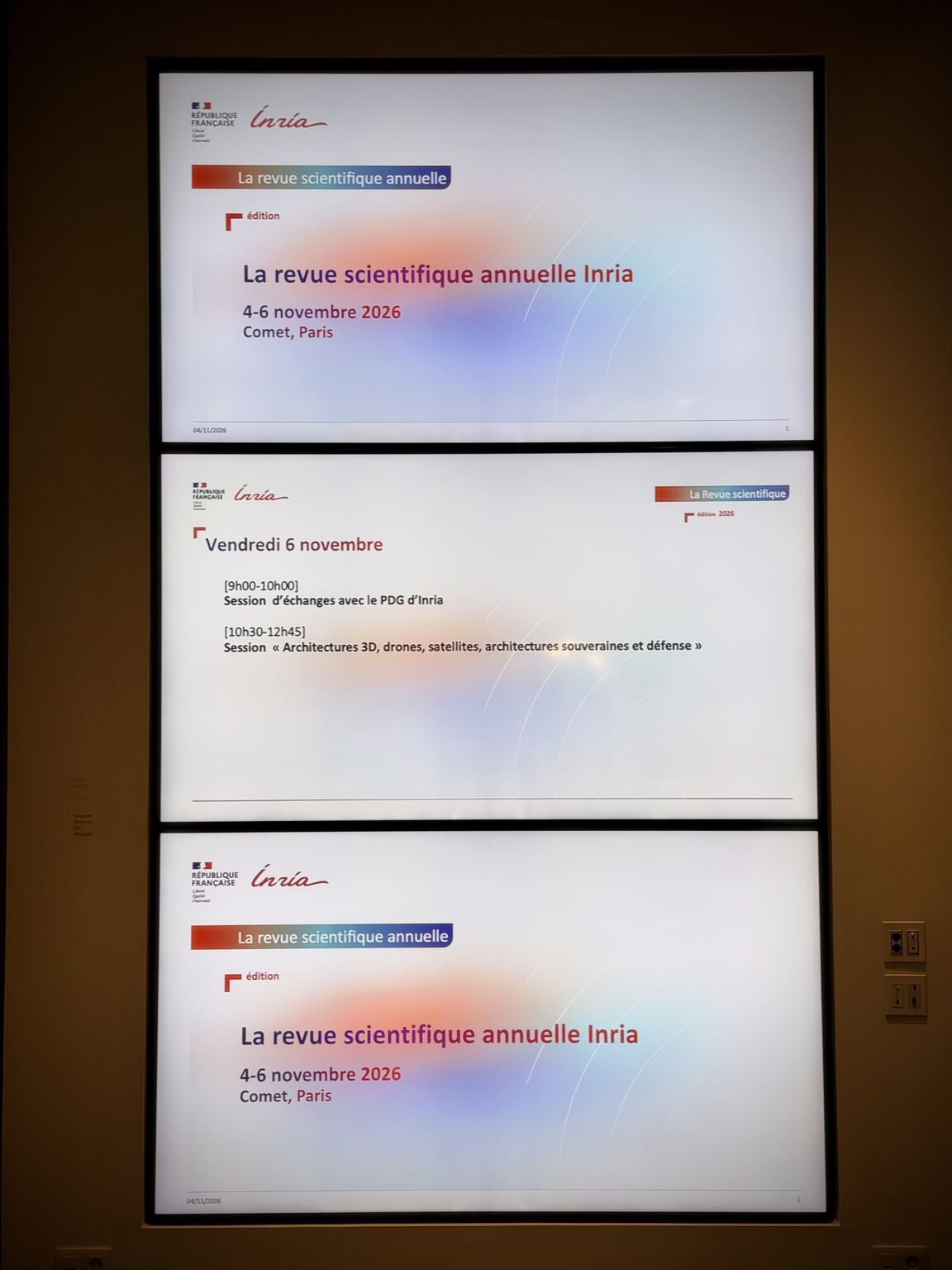
    The Revue Scientifique annuelle (4–6 Nov, Paris) is where Inria takes stock of its core research topics. AI ran through all three days, and space got a lot of attention: a full session on non-terrestrial networks, coordinated by Oana I. and Maxime Guillaud.

    I was one of the first space-specific profiles at Inria, when space was mostly seen as an engineering discipline. I am happy to see space growing within computer science at Inria!

    🎤 My talk, AI for Space, Space for AI: The Rise and Limits of the Space Cloud, crossed:
    🤖 AI for Space: optimize what you can model, learn what shifts
    ☁️ Space for AI: data-center orbits and architecture design

    And since AI was everywhere this week, my take: the deck's renders were built with AI. Use it to make hard ideas visible! Check it yourself:
    🔗 Slides: juanfraire.space/talks/2026-11-inria-revue

    🙏 Thanks to Oana and Maxime, and to François Baccelli, Christelle Caillouet, Marco Tognon, Jocelyn Chanussot and Jean-Pierre Diris for a session that went from Walker constellations to IRIS².

    #Inria #SpaceNetworking #NTN #SatelliteNetworks #SpaceCloud #OrbitalComputing #AIforSpace #SpaceForAI
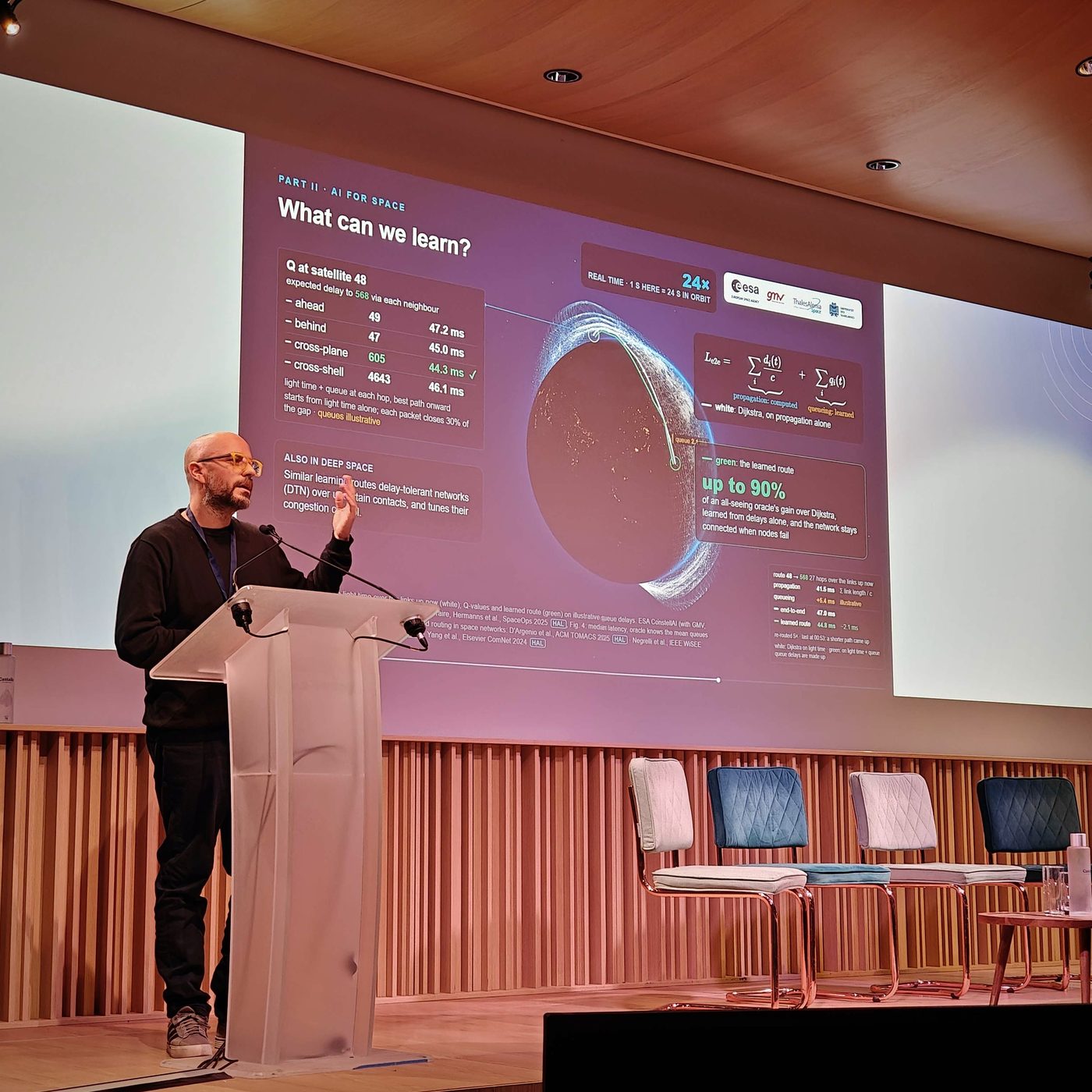
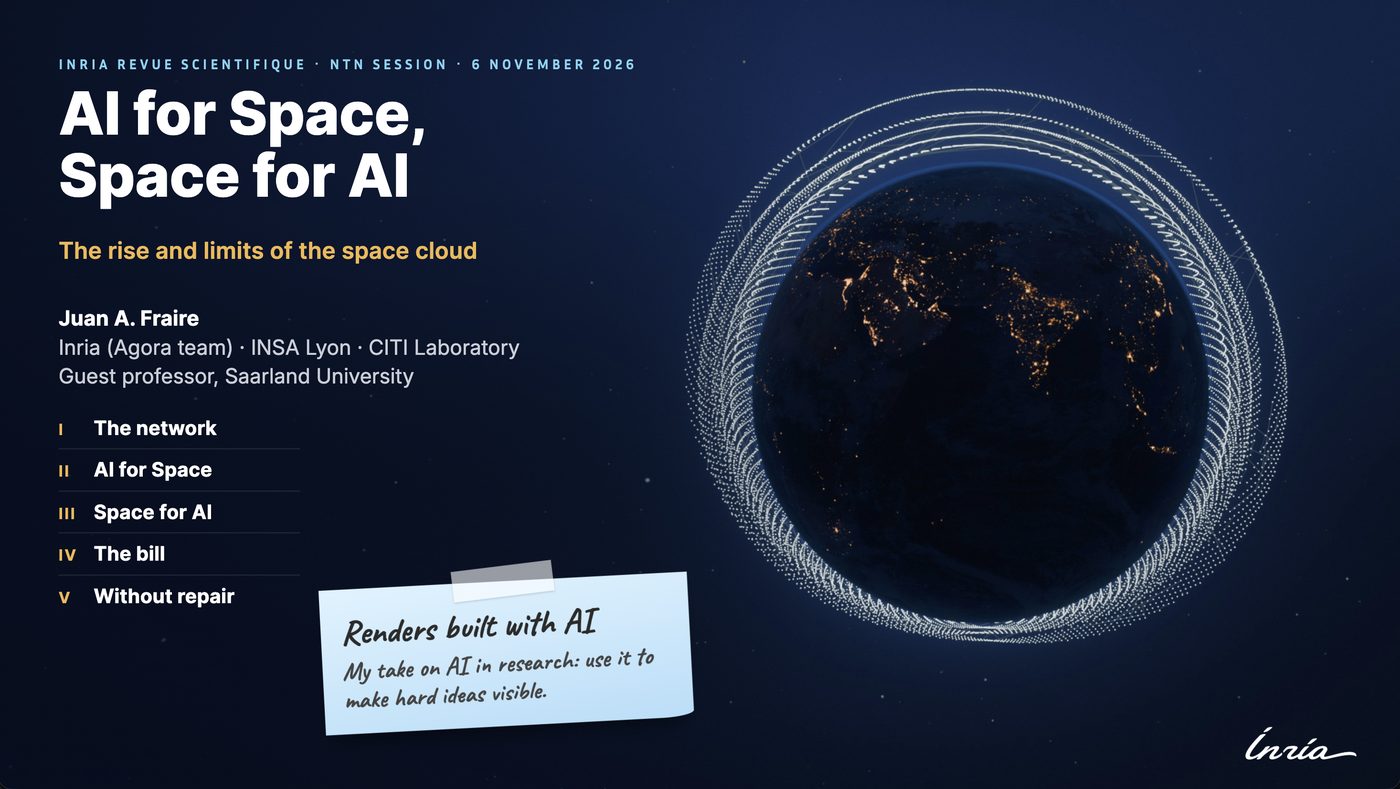
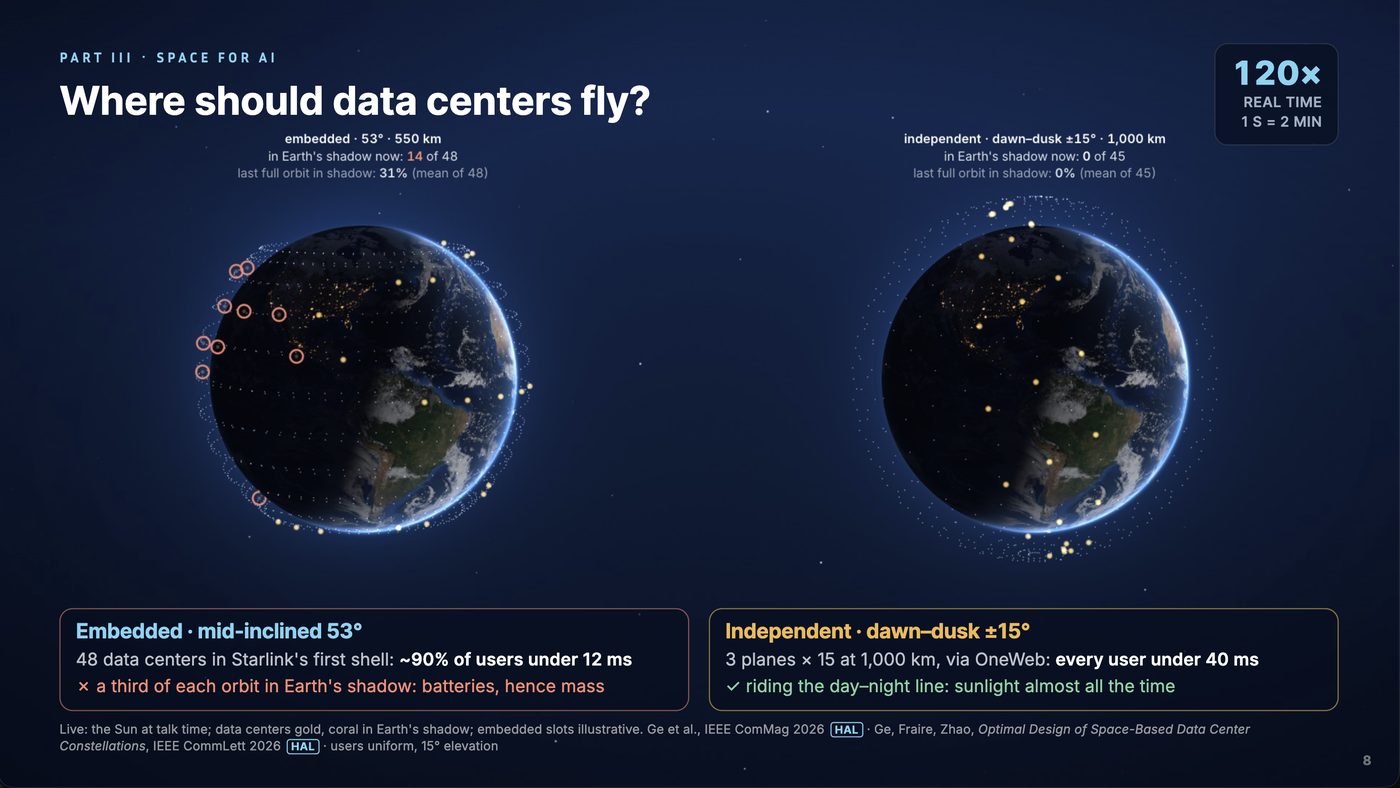
    Juan Fraire speaking at the lectern in front of the slide "What can we learn?", which compares a learned satellite route with Dijkstra on a 3D Earth Title slide "AI for Space, Space for AI: The rise and limits of the space cloud", with the five parts of the talk, a sticky note reading "Renders built with AI", and a ring of satellites around the night-side Earth Slide "Where should data centers fly?": two globes compare data centers embedded in Starlink's 53° shell, a third of each orbit in Earth's shadow, with an independent dawn–dusk constellation that stays in sunlight Three screens at the venue announcing La revue scientifique annuelle Inria, 4–6 November 2026, Comet, Paris, and Friday's session on 3D architectures, drones, satellites, sovereign architectures and defence

    On LinkedIn

  2. 🛰️ Working on satellite IoT? Bring it to Santiago! 🇨🇱

    Everyone working on IoT is invited to submit!

    I'd especially like to see the satellite IoT community there: direct-to-satellite IoT, NTN for massive IoT, LoRa and NB-IoT from orbit, constellations for sensing and connectivity.

    Your papers will be in good hands: my Lyon colleague Oana I. (INSA Lyon, Inria) is TPC Chair.

    📅 Deadline: 28 November 2026
    📝 Short papers (up to 4 pages, work in progress welcome) or full papers (up to 6 pages)
    📚 Papers presented in person go to IEEE Xplore
    📍 Santiago, Chile, 28–30 April 2027
    🌐 latiniot2027.iot.ieee.org

    #LatinIoT2027 #IEEE #IoT #SatelliteIoT #NTN #CallForPapers #Chile

    Only one month left to submit your research to IEEE Latin-IoT 2027! 📅 Deadline: November 28, 2026IEEE Latin-IoT 2027 on LinkedIn

    On LinkedIn

  3. 🛰️ AI for Space has decades of science behind it. Space for AI is a race without one.

    That's where my keynote at AIxNET 2026 goes:
    🔵 AI for Space: learning that designs and operates space fleets.
    🟣 Space for AI: orbital infrastructure that hosts computing.

    🎤 Keynote 1, Monday 23 November, 17:30, Inria Paris

    Thanks to the AI4CI European Master and the AIxNET organizers for the invitation.

    🔗 Abstract: aixnet.org/keynotes

    #AIxNET2026 #SpaceCloud #OrbitalComputing #SatelliteNetworks #AIforSpace #SpaceForAI #6G #Inria
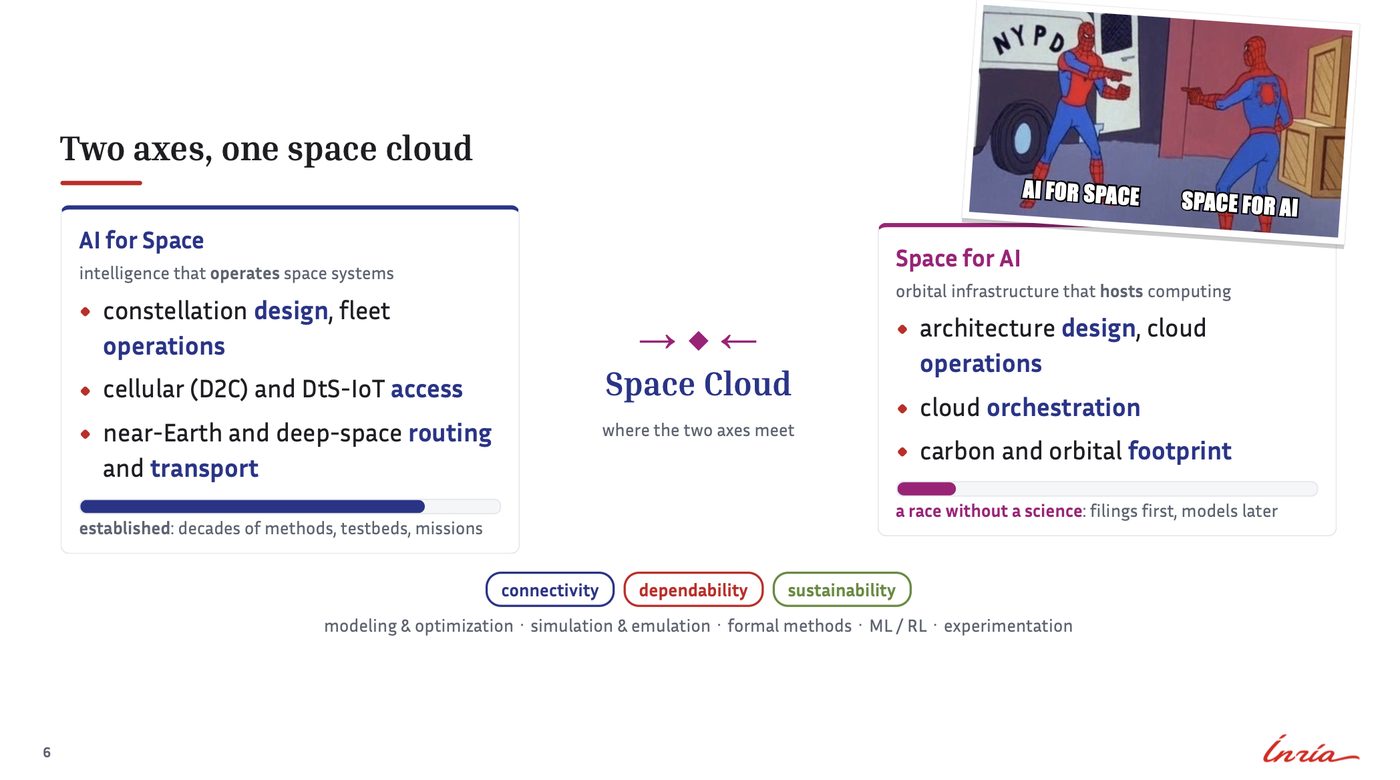
    Keynote slide "Two axes, one space cloud": AI for Space, intelligence that operates space systems, is established with decades of methods, testbeds and missions; Space for AI, orbital infrastructure that hosts computing, is a race without a science, filings first and models later. Both meet in the Space Cloud. A Spider-Man pointing meme labels the two axes.
    🚀 AIxNET 2026: Where Artificial Intelligence Meets the Networks of Tomorrow!European AI4CI Master on LinkedIn
    On LinkedIn

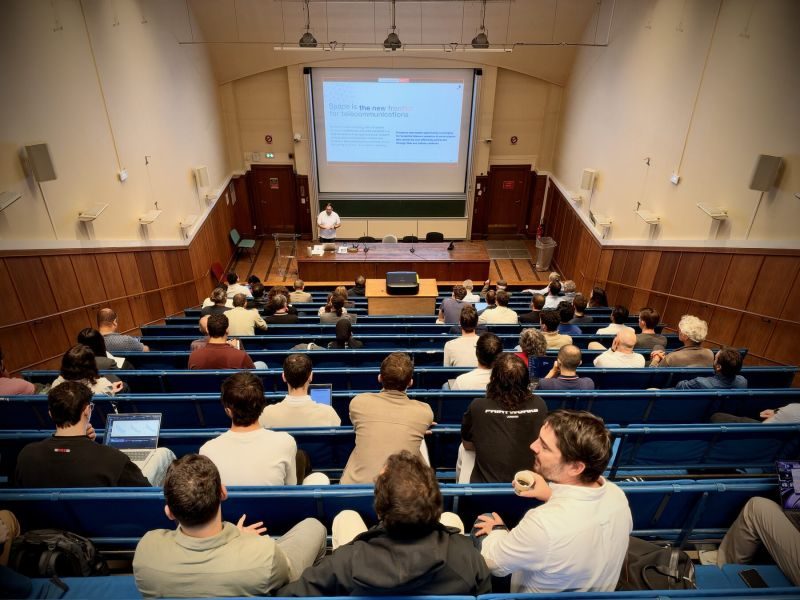
  4. 🛰️ ~70 people, two days at the Cnam in Paris, one topic: Non-Terrestrial Networks at the NTN Days 2026!

    🎤 2 keynotes by Hassan Fawaz (Univity) and Francois Baccelli (Inria, Télécom Paris, LINCS)
    📊 21 talks across four sessions
    🖼️ 1 poster session with student posters and live demos
    💬 A roundtable on NTN
    🎟️ Free to attend, thanks to the Cnam, GDR RSD, GDR IASIS and Inria

    🔗 More info is online: ntndays.space

    🙏 Thank you to Vania Conan and Pengwenlong GU for co-organising, to the Cnam teams who made the amphitheatre run, and to everyone who travelled and presented.

    📍 The 5th edition goes to IRISA, Rennes, 2027. See you all there :)

    #NTN #SatelliteCommunications #6G #SpaceNetworks #GDRRSD

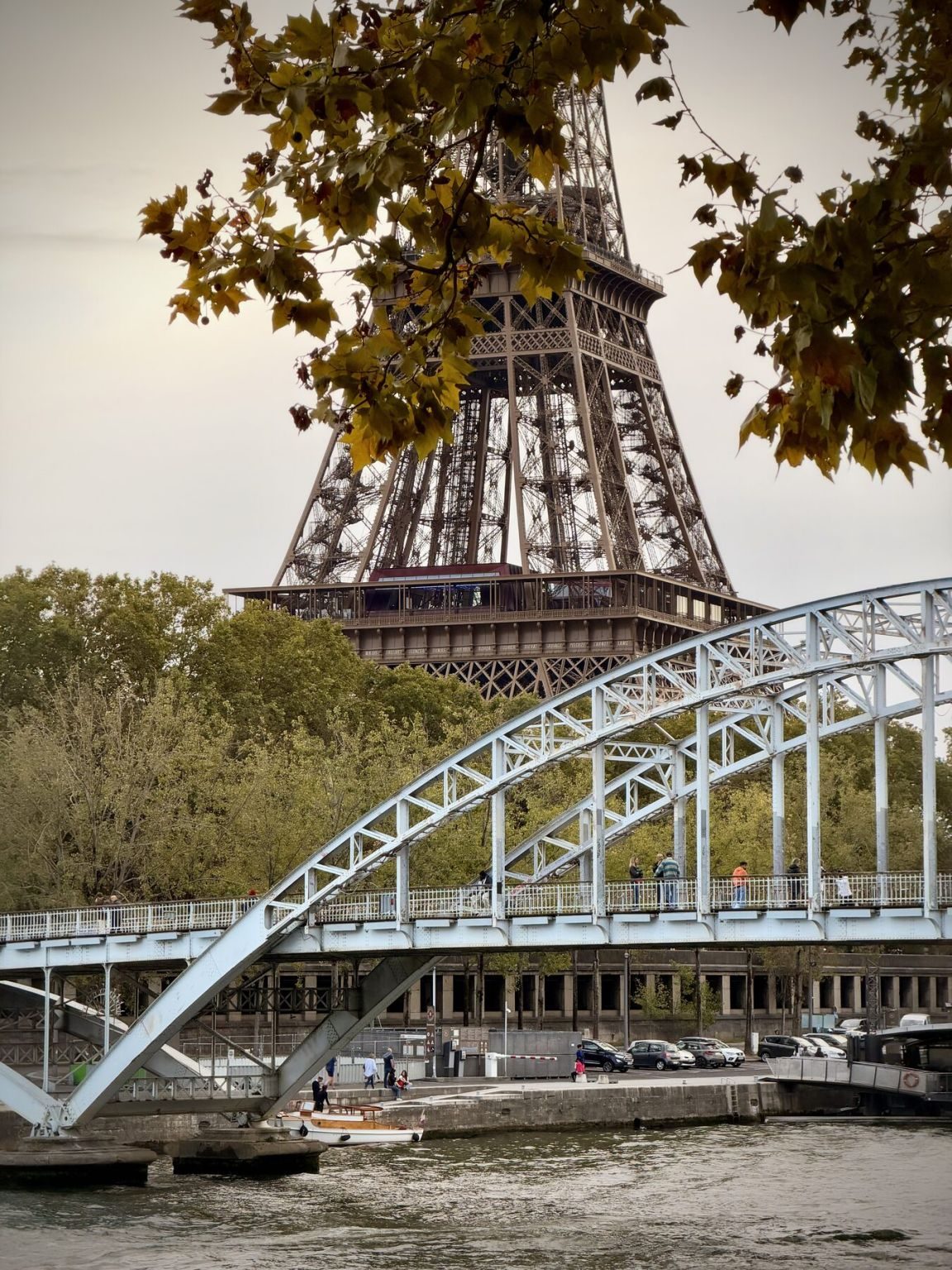
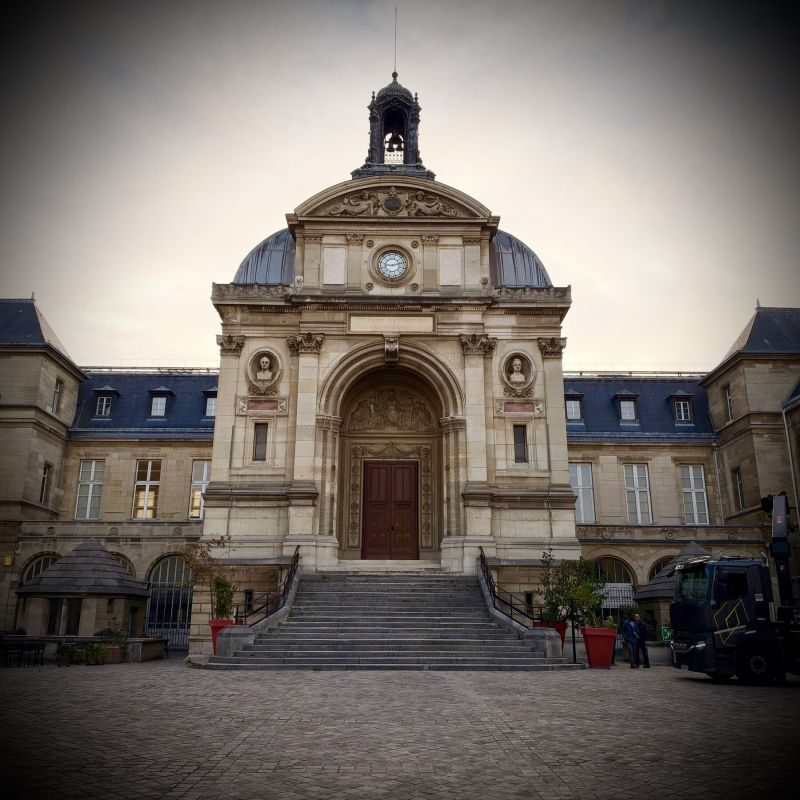
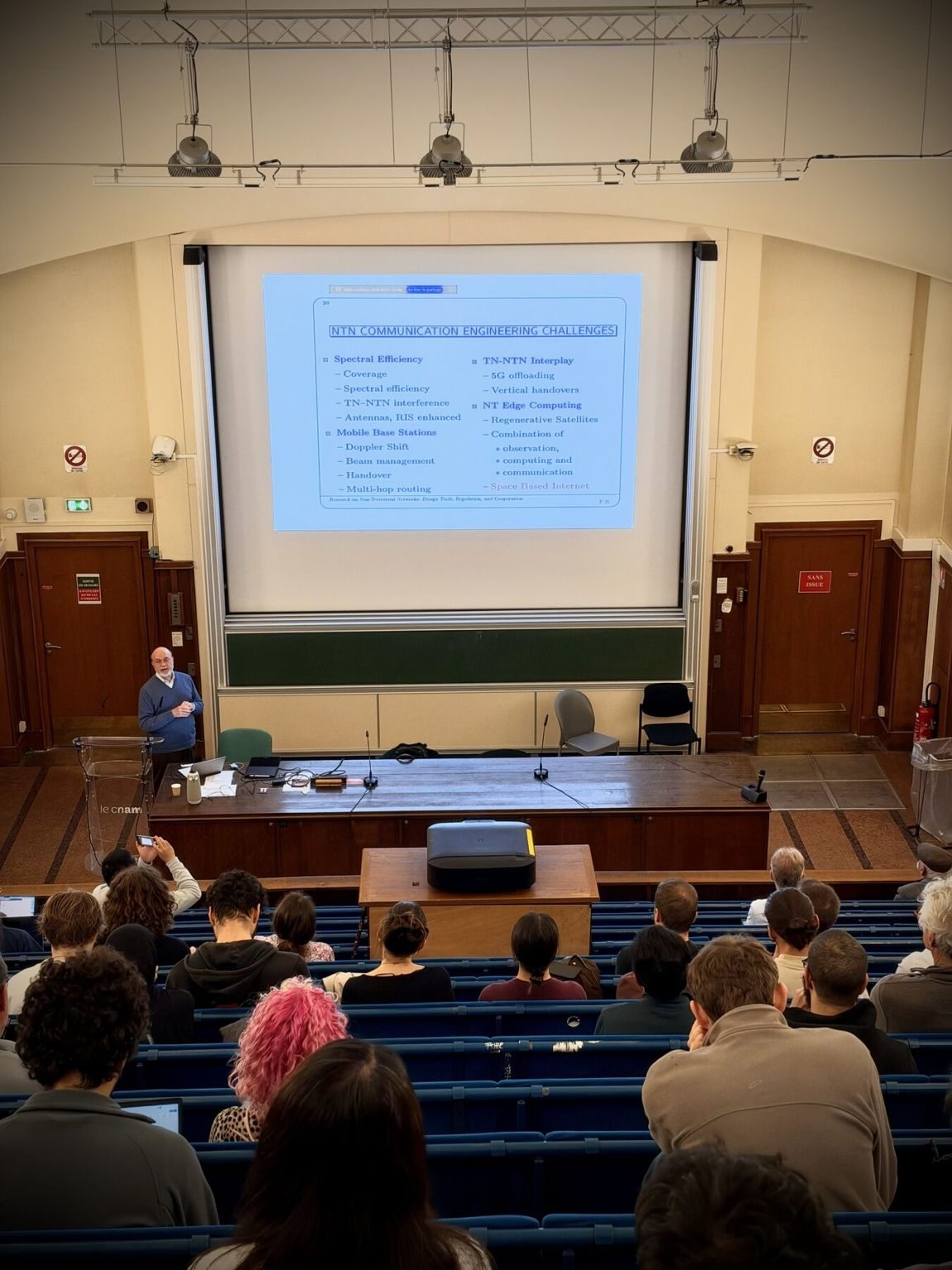
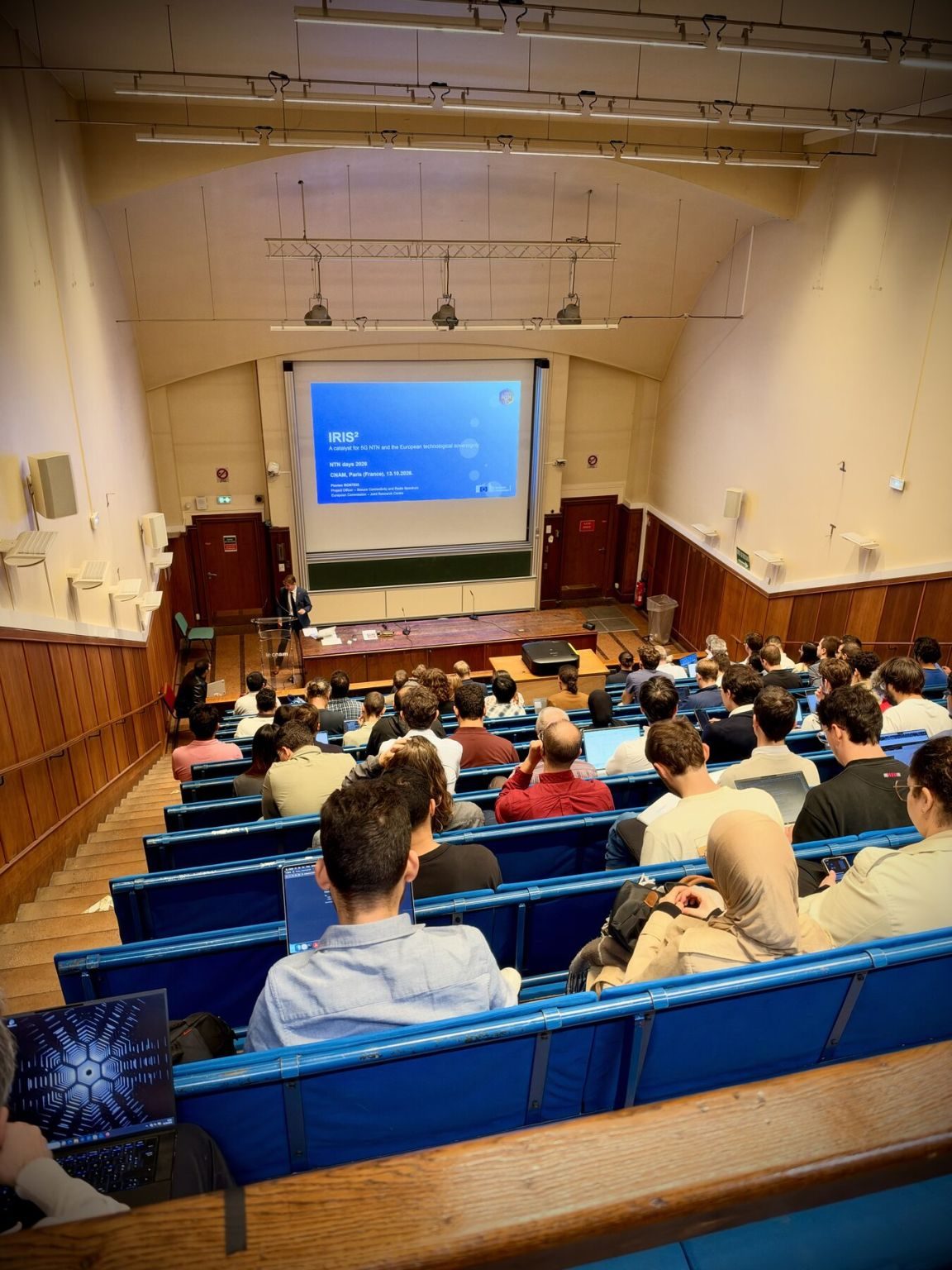
    The Eiffel Tower behind the Debilly footbridge over the Seine, framed by autumn leaves The Cnam amphitheatre seen from the back rows during a talk, the slide reading "Space is the new frontier for telecommunications" The main entrance of the Cnam in Paris, a domed stone building with a clock and a bell tower above its doors A speaker beside a slide on NTN communication engineering challenges, from spectral efficiency to edge computing, in front of a full amphitheatre A talk on IRIS² as a catalyst for 5G NTN and European technological sovereignty, seen from the top of the amphitheatre with the audience below

    On LinkedIn

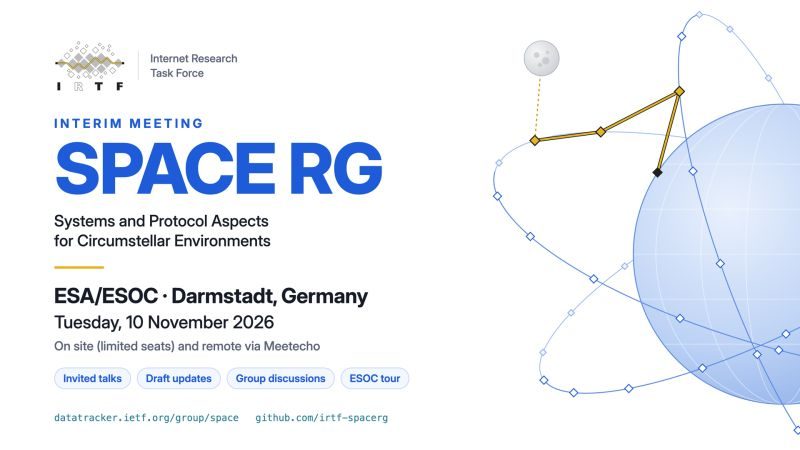
  5. SPACE RG is coming to ESA/ESOC 🛰️ Join us in Darmstadt on 10 November!
    The next interim meeting of the IRTF SPACE RG will take place at ESA's European Space Operations Centre (ESOC) in Darmstadt, Germany, on Tuesday, 10 November 2026.

    The idea is to bring the IETF/IRTF closer to the space community.

    🗓️ What to expect
    • A full day of technical talks on space networking
    • Updates on SPACE RG drafts
    • Interactive group discussions
    • Coffee, lunch, and a tour of the ESOC facilities

    🎤 Confirmed speakers so far
    • Tomaso de Cola (DLR): Earth-to-Moon networking, comparing end-to-end and DTN approaches
    • Andreas Schmidt (Saarland University): sustainable space networking
    • Maxime Piraux (Aerospacelab): where IETF and industry visions for constellation networks meet

    📍 How to join
    On-site seats are limited, so if you plan to come to Darmstadt, let us know early. We'll send registration and access details to the SPACE RG mailing list. You can also join remotely via Meetecho.

    📣 Working on something relevant to SPACE RG? The call for talks is still open. Send me or the list a tentative title and a short description.

    🔗 Mailing list: mailman3.irtf.org/mailman3/lists/space.i…
    🔗 Group page: datatracker.ietf.org/group/space
    🔗 Materials: github.com/irtf-spacerg
    🔗 Space networking tools registry: irtf-spacerg.github.io/id-leo-tools/regi…
    🔗 Satellite constellation registry: irtf-spacerg.github.io/id-leo-constellat…

    Thanks to ESA/ESOC for hosting, especially to Felix Flentge for the arrangements.

    SPACE RG will not meet at IETF 127 in San Francisco, so Darmstadt is where to catch up with the group this autumn. See you there!

    #IETF #IRTF #SpaceNetworking #SatelliteNetworks #LEO #DTN #Cislunar #NTN #ESA #ESOC

    SPACE RG interim meeting at ESA/ESOC in Darmstadt, Germany, on Tuesday 10 November 2026, on site with limited seats and remote via Meetecho: invited talks, draft updates, group discussions and an ESOC tour

    On LinkedIn

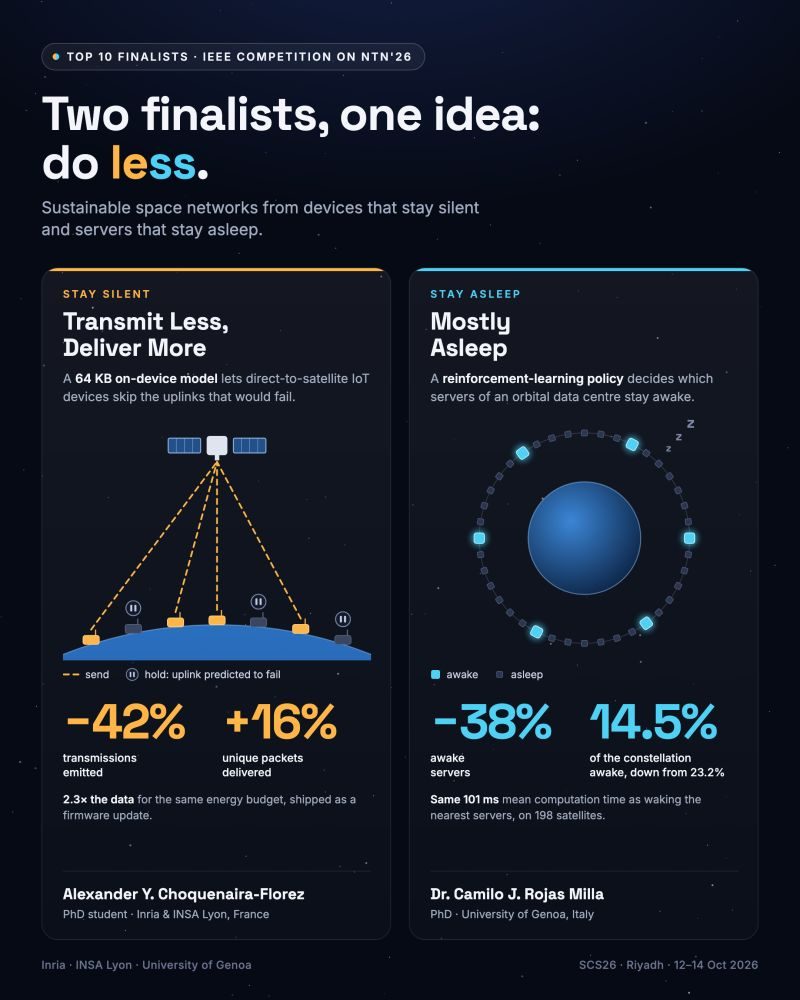
  6. Two of my PhD students are among the ten finalists of the IEEE Competition on Non-Terrestrial Networks (NTN'26) 🛰️ 🎉

    🟠 Transmit Less, Deliver More: Alexander Ylnner Choquenaira Florez, PhD student at Inria Lyon.
    🔵 Mostly Asleep: Dr. Camilo Rojas Milla, PhD from the University of Genoa.

    Two layers, one shared idea: in space, the most sustainable operation is often the one you skip.

    The top 3 will be announced on 12 October at SCS26 in Riyadh. Camilo will be there to present both works, his own and Alex's.

    Congratulations to both! Many thanks to my fellow supervisors Hervé Rivano and Fabio Patrone, and to the IEEE ComSoc Satellite & Space Communications TC and CST for organizing the competition Gunes Karabulut Kurt Giovanni Giambene Tomaso de Cola.

    🔗 scs26.sa/ieee-competition-ntn26

    #NonTerrestrialNetworks #SpaceSustainability #DirectToSatellite #OrbitalComputing #NTN

    Poster, Two finalists, one idea: do less. Alexander Y. Choquenaira-Florez's on-device model lets direct-to-satellite IoT devices skip uplinks that would fail: 42% fewer transmissions, 16% more unique packets. Camilo J. Rojas Milla's reinforcement-learning policy keeps 14.5% of an orbital data centre's servers awake, down from 23.2%

    On LinkedIn

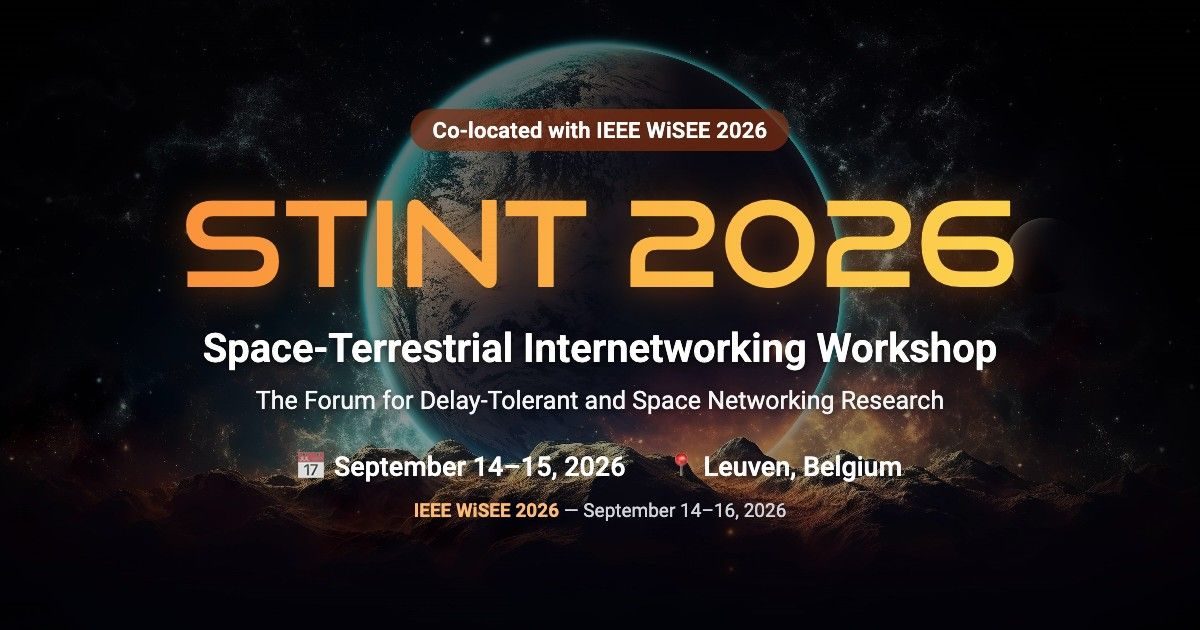
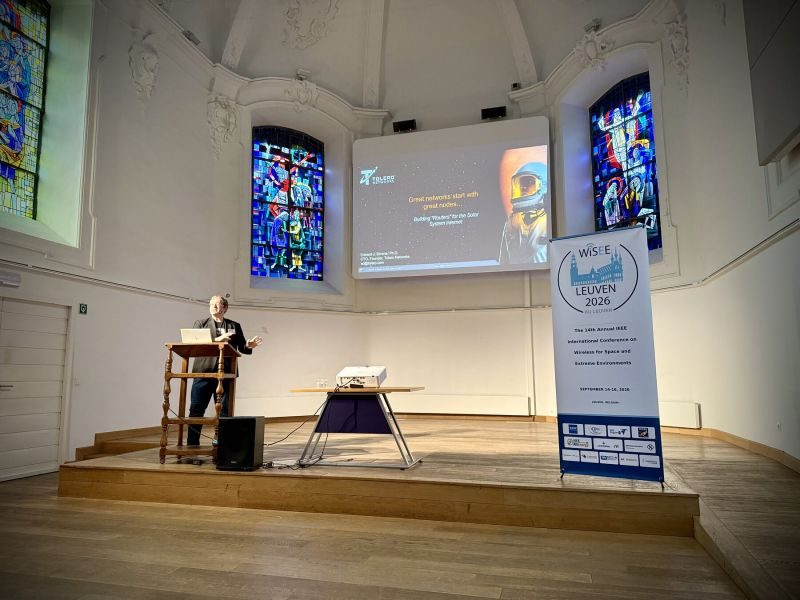
  7. 🛸 STINT 2026 is a wrap 🛸

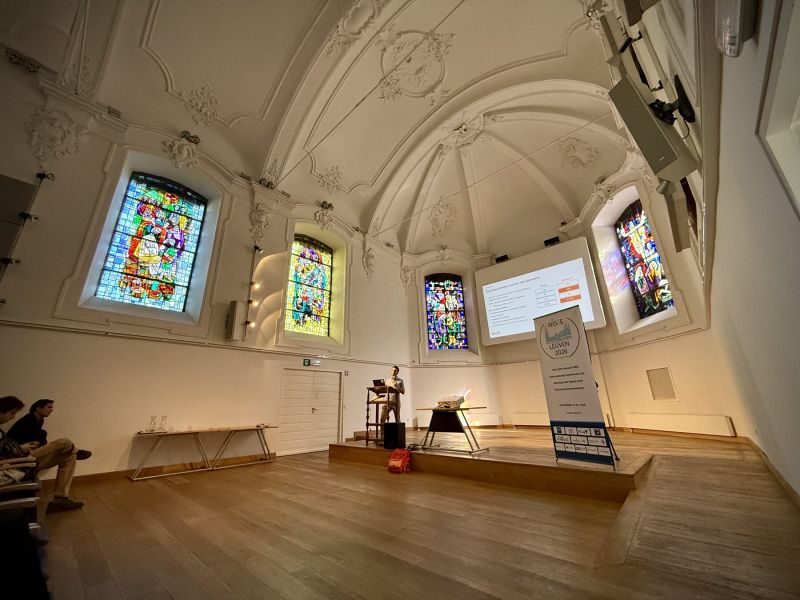
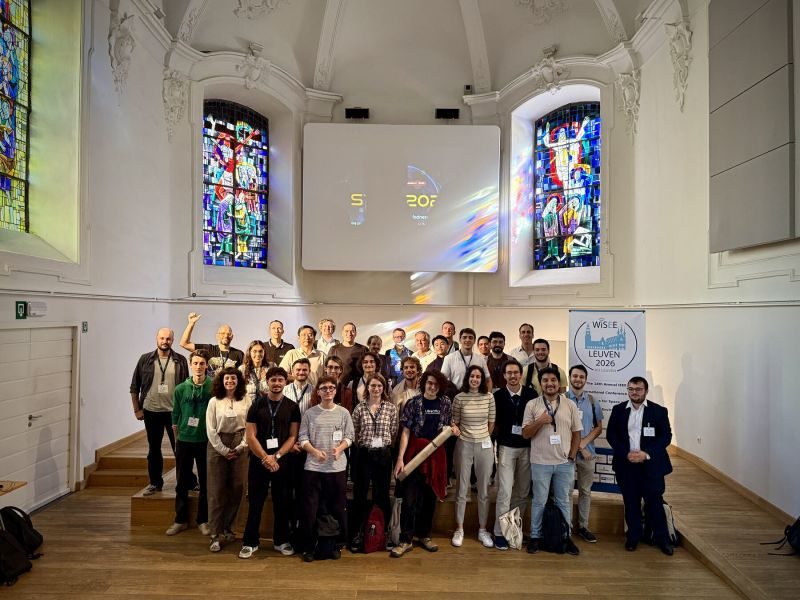
    Two days at the Irish College in Leuven 🇧🇪, co-located with IEEE WiSEE 2026, for the 13th edition of the Space-Terrestrial Internetworking Workshop 🛰️.

    The programme
    🔸 4 keynotes: Ed Birrane (Tolero Networks), Marius Feldmann (D3TN), Felix Flentge (ESA), Dr. Alberto Montilla (Spatiam)
    🔸 4 invited talks, 10 peer-reviewed papers, 9 posters
    🔸 Dedicated MISSION (mission-project.eu) and D3-CONNECT (d3-connect.space) sessions
    🔸 A closing panel on where DTN and the Internet meet, with Kanglian Zhao (Nanjing University) joining the keynote speakers

    Slides and photos from both days are online: stintworkshops.org

    Thank you to Ali Abedi and the IEEE WiSEE team, to KU Leuven for the venue, and to our sponsors D3TN, IPNSIG and the MISSION project.

    STINT 2027 is in planning. Watch this space.

    #DTN #SpaceNetworking #DelayTolerantNetworking #IEEEWiSEE #InterplanetaryInternet

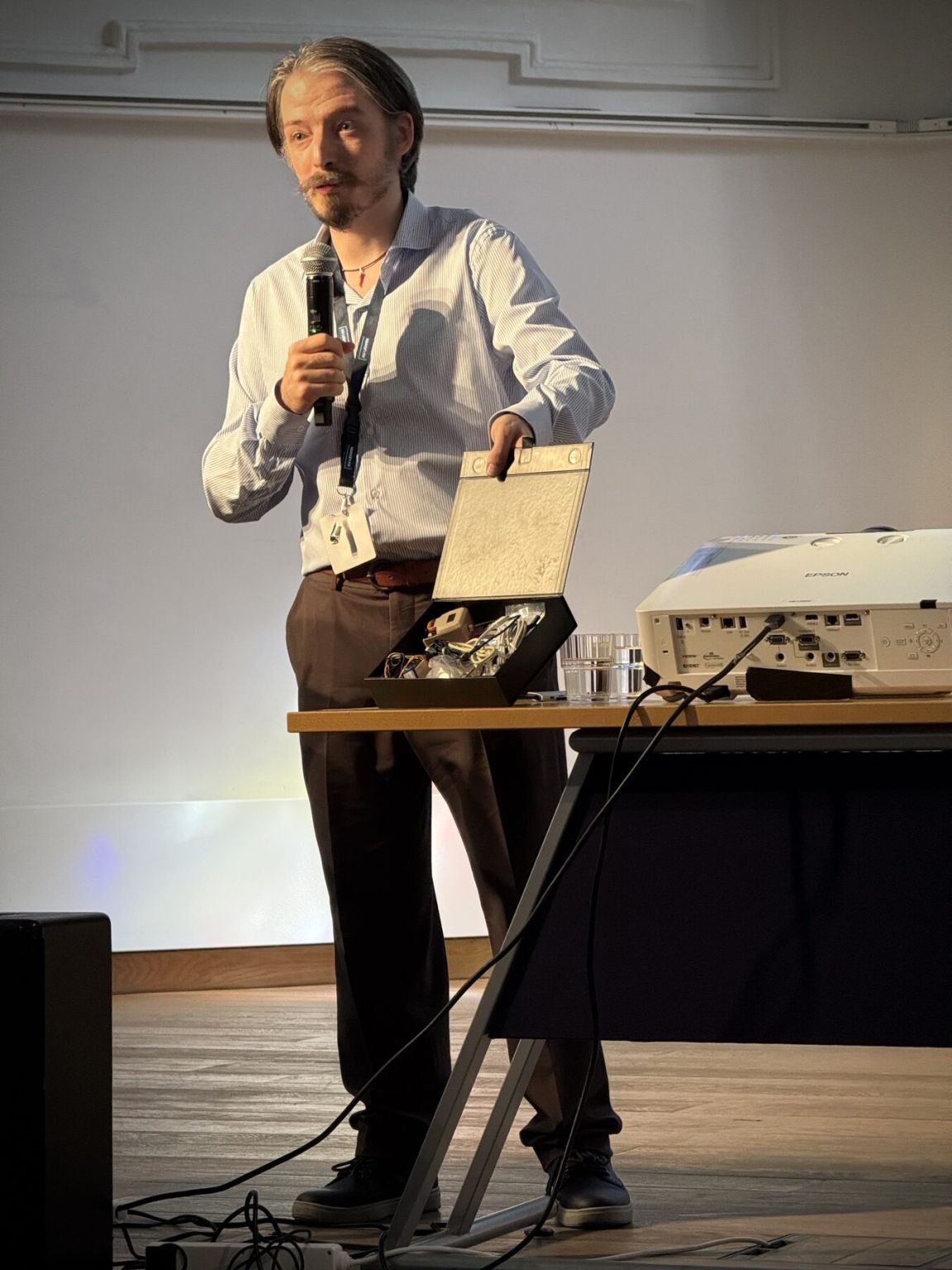
    STINT 2026 banner: Space-Terrestrial Internetworking Workshop, 14 to 15 September 2026, Leuven, Belgium, co-located with IEEE WiSEE 2026 Group photo of the STINT 2026 participants in a hall with stained-glass windows The workshop hall, with a talk on the screen between the stained-glass windows A speaker at the lectern during a session A speaker with a microphone, holding an open hardware case during a demonstration

    On LinkedIn

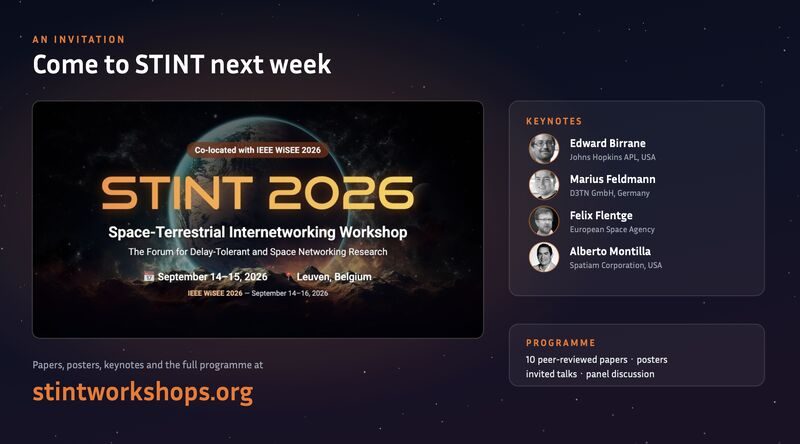
  8. 🚀 Come to STINT 2026 next week!

    Join us in Leuven, Belgium, on Sep 14–15 for the Space-Terrestrial Internetworking Workshop, co-located with IEEE WiSEE 2026.

    We have a great programme of peer-reviewed papers, posters, invited talks, keynotes, and a panel discussion.

    👉 Programme & details: stintworkshops.org

    Hope to see you there! 🛰️🌍

    #STINT2026 #SpaceNetworking #DTN #SatelliteNetworks #WiSEE2026

    Invitation to STINT 2026 in Leuven, Belgium, 14 to 15 September, with keynotes by Edward Birrane, Marius Feldmann, Felix Flentge and Alberto Montilla

    On LinkedIn

  9. 🚀 Last call for talks — NTN Days 2026! (October 13–14 in Paris 🇫🇷)

    If you are working on Non-Terrestrial Networks and would like to share your latest work, there is still time to propose a talk.

    👉 No full paper required — just a title and a short abstract.

    📅 Official submission deadline: September 4.

    And, well… the submission form is unlikely to turn into a pumpkin exactly at midnight 😉 But earlier is definitely better!

    🔗 ntndays.space

    #NTNDays #NTN #SatelliteCommunications #6G #5G #SatelliteNetworks #SpaceCommunications #IoT #DTN

    NTN Days 2026 | Non-Terrestrial Networks Conference — Parisntndays.space

    On LinkedIn

  10. Dark Clouds Rising in Low-Earth Orbit, on the environmental limits of orbital AI, at the LEO-NET workshop of ACM SIGCOMM in Denver.

    Paper

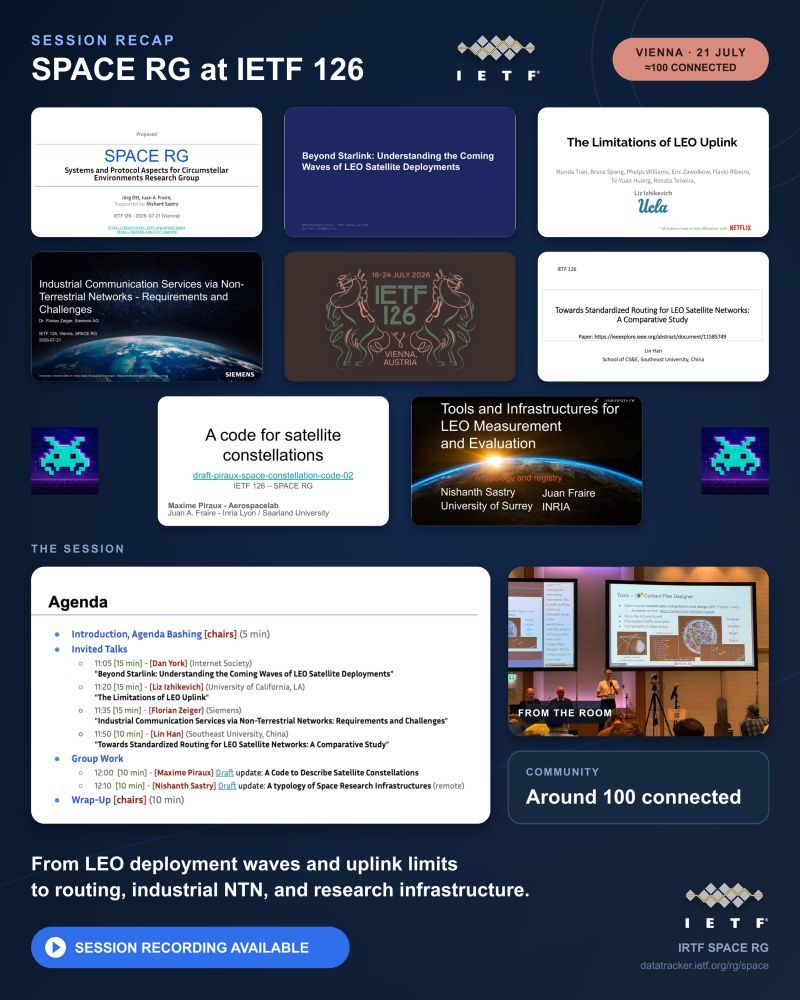
  11. Our SPACE RG 🛰️ session at IETF 126 in Vienna brought together around 100 participants again. 🚀

    We heard invited talks spanning the next waves of LEO satellite deployments, the Limitations of LEO uplinks, requirements and challenges for Industrial communication over NTN, and comparative approaches to Standardized routing for LEO constellations.

    The group also moved ongoing work forward with updates on:
    🧩  a code for describing satellite constellations; and
    🔭 a typology of space research infrastructures.

    A big thank-you to Dan York, Liz Izhikevich, Florian Zeiger, Lin Han, Maxime Piraux, Nishanth Sastry, and everyone who joined the discussion - in Vienna and remotely.

    ▶️ Watch the full session:
    youtu.be/cCir6Oqjzq0

    🔗 Learn more about SPACE RG:
    datatracker.ietf.org/rg/space/about

    #IETF126 #IRTF #SpaceNetworking #SatelliteNetworks #LEO #NTN #InternetResearch

    Collage recapping the SPACE RG session at IETF 126 in Vienna on 21 July: title slides of the talks, the agenda, a photo from the room, and around 100 people connected

    On LinkedIn

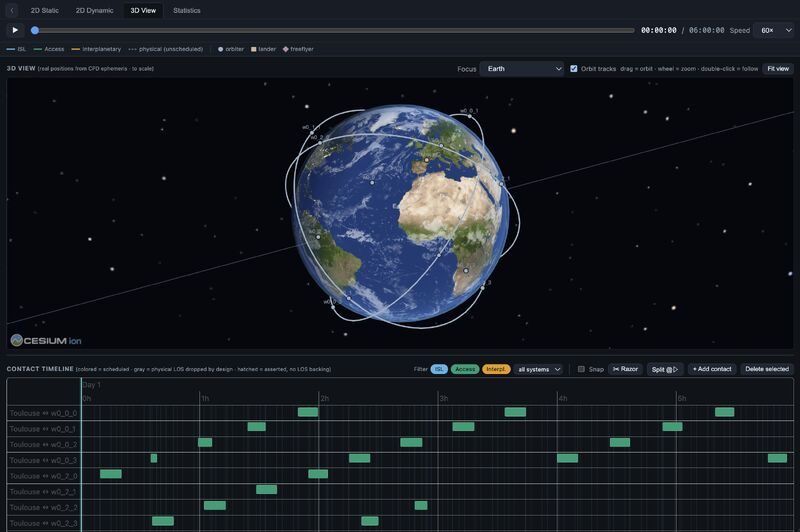
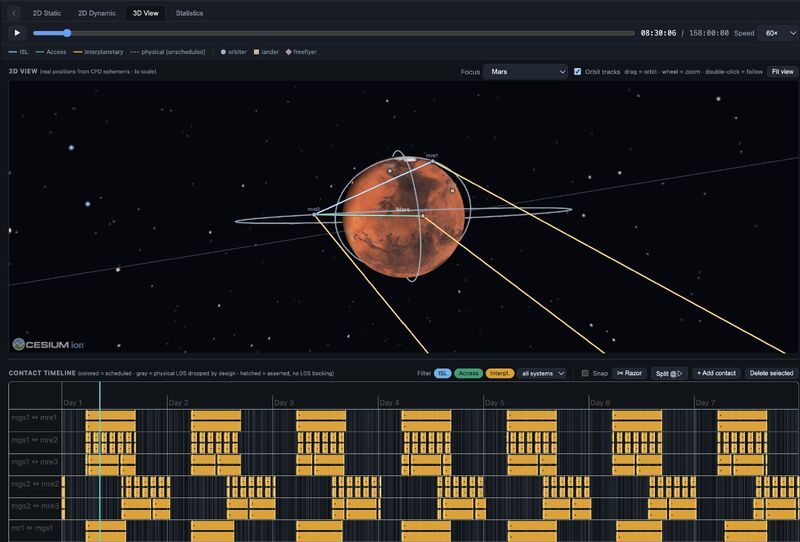
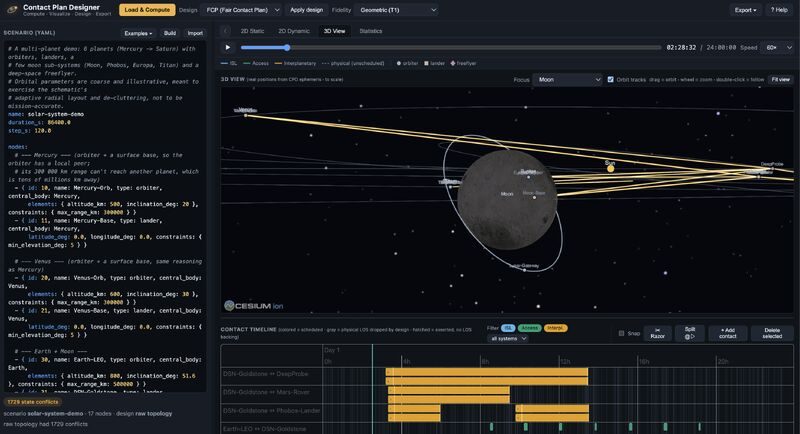
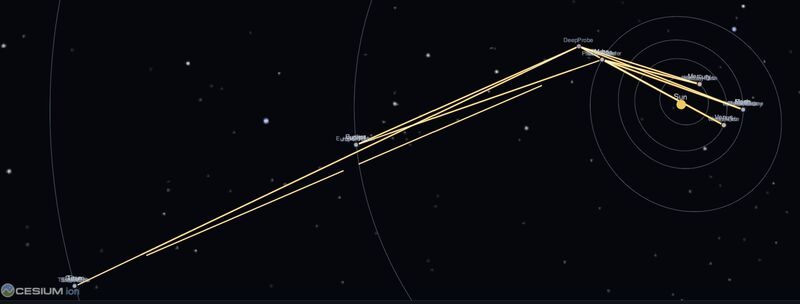
  12. Building a space network? 🛰️ Meet Contact Plan Designer: the open-source, contact-plan tooling at solar-system scale.

    🔭 Compute — light-time-corrected contacts, multi-body occlusion, range, elevation, antenna cone, per-contact OWLT.
    📊 Visualize — an editable 2D timeline + a to-scale 3D CesiumJS viewer + a live stats dashboard.
    🧩 Design — the Fair Contact Plan solver resolves interface conflicts, prioritizing starved links so none get left behind.
    📤 Export — ION · HDTN · TVR · IPN-V · STK Access/AER · Sunlight windows.

    All from one pure-Python core (CLI, web app, or library).

    Try it here! Happy to receive feedback 👉 contact-plan-designer.space

    #DTN #SpaceNetworks #OpenSource #Aerospace #ION #InterplanetaryInternet

    Contact Plan Designer: a 3D view of Earth with satellite orbits, above a timeline of scheduled contacts Contact Plan Designer: a 3D view of Mars and its orbiters with links, above a dense contact timeline Contact Plan Designer: a scenario file being edited on the left and a 3D view of the Moon with its contacts on the right Contact Plan Designer: links between spacecraft drawn across the inner Solar System

    On LinkedIn

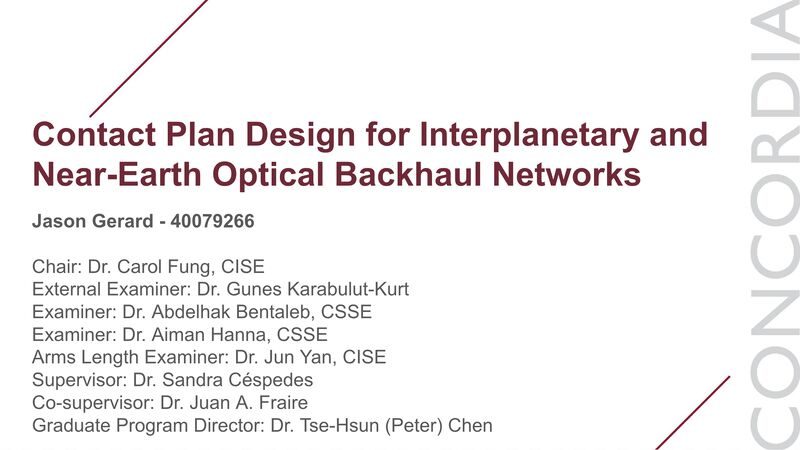
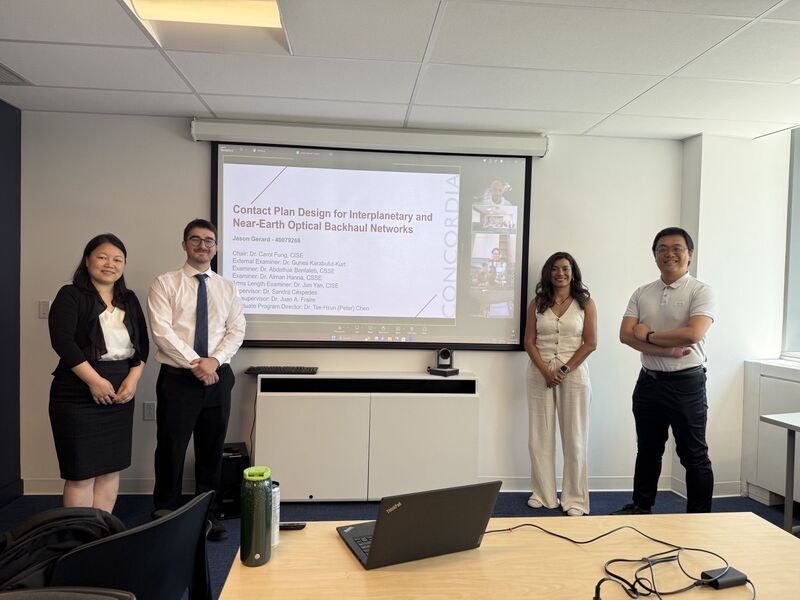
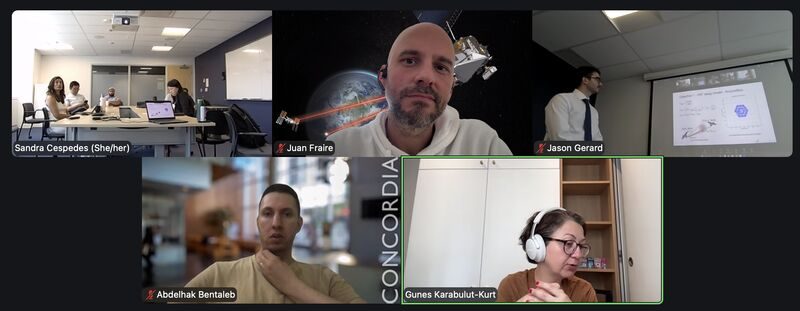
  13. Today Dr. Jason Gerard defended his PhD at Concordia University, and the committee's verdict was unanimous: Outstanding. 🎓🛰️

    It has been a huge honour and a genuine pleasure to co-supervise Jason alongside Sandra Céspedes over these years.

    Three papers capture the arc of his Contact Plan Design for Interplanetary and Near-Earth Optical Backhaul Networks thesis:

    🪐 Contact Plan Design for Optical Interplanetary Communications (arXiv:2601.18148)
    🎯 Modeling Pointing, Acquisition, and Tracking Delays in Free-Space Optical Satellite Networks (IEEE WiSEE 2025)
    🌐 Autonomous Max-Flow Interplanetary Laser Link Scheduling for Martian Exploration (IEEE WiSEE 2024)

    My sincere thanks to the examining committee for their careful reading and sharp questions.

    I look forward to what comes next. 🚀

    Jason Gerard Sandra Céspedes Gunes Karabulut Kurt

    #PhD #SpaceCommunications #OpticalCommunications #DeepSpace #FreeSpaceOptics #Concordia #DTN

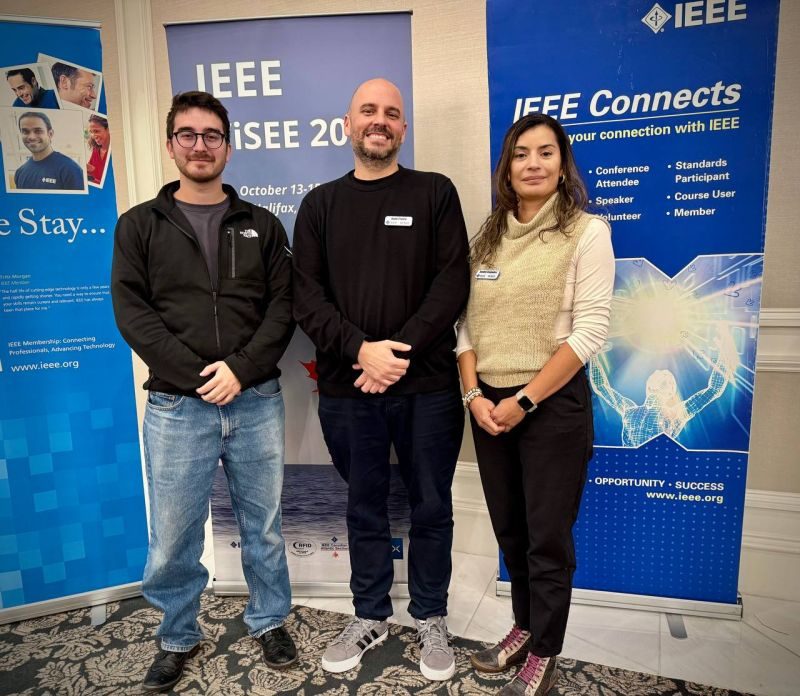
    Title slide of the defence: Contact Plan Design for Interplanetary and Near-Earth Optical Backhaul Networks, by Jason Gerard, Concordia University, with the examining committee listed Jason Gerard and three members of the committee in front of the projected title slide Video call during the defence, with tiles for Sandra Céspedes, Juan Fraire, Jason Gerard, Abdelhak Bentaleb and Gunes Karabulut-Kurt Three people in front of IEEE WiSEE conference banners

    On LinkedIn

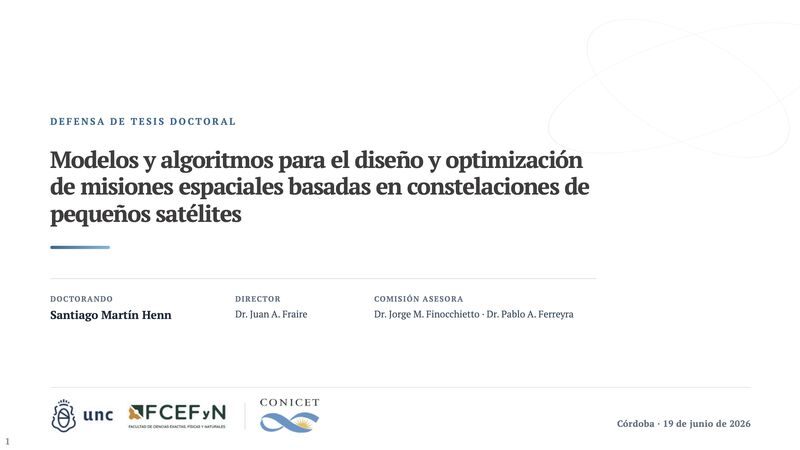
  14. Santiago Martín Henn has just defended his PhD thesis entitled:

    "Models and algorithms for the design and optimization of space missions based on small satellite constellations"

    at the Facultad de Ciencias Exactas Físicas y Naturales of the UNC.

    It was a huge pleasure to supervise Santi, now my friend, through a thesis at the intersection of astrodynamics and computer science, a line of work that spans both papers he led and standout collaborations:

    🛰️ S. M. Henn, J. A. Fraire, and H. Hermanns, "Polygon-Based Algorithms for N-Satellite Constellations Coverage Computing," IEEE Transactions on Aerospace and Electronic Systems, vol. 59, no. 5, pp. 7166–7182, 2023.

    📡 G. Maiolini Capez, S. Henn, J. A. Fraire, and R. Garello, "Sparse Satellite Constellation Design for Global and Regional Direct-to-Satellite IoT Services," IEEE Transactions on Aerospace and Electronic Systems, vol. 58, no. 5, pp. 3786–3801, 2022.

    🔭 R. Ortigueira, S. Montejo-Sánchez, S. Henn, J. A. Fraire, and S. Céspedes, "Satellite Visibility Prediction for Constrained Devices in Direct-to-Satellite IoT Systems," IEEE Sensors Journal, 2024.

    🌐 J. A. Fraire, S. Henn, G. Stock, R. Ohs, G. Stock, H. Hermanns, et al., "Quantitative Analysis of Segmented Satellite Network Architectures: A Maritime Surveillance Case Study," Computer Networks, vol. 255, art. 110874, 2024.

    Congratulations, Dr. Henn. Proud of you. 🎓

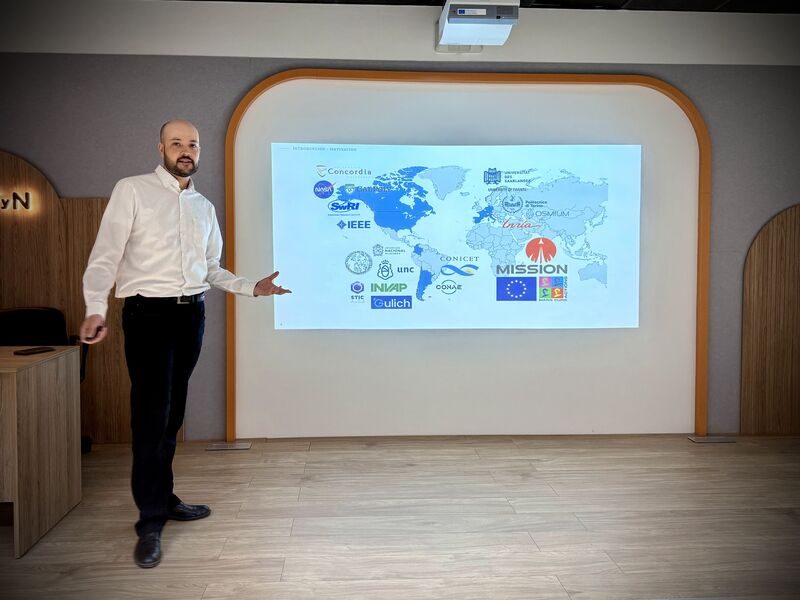
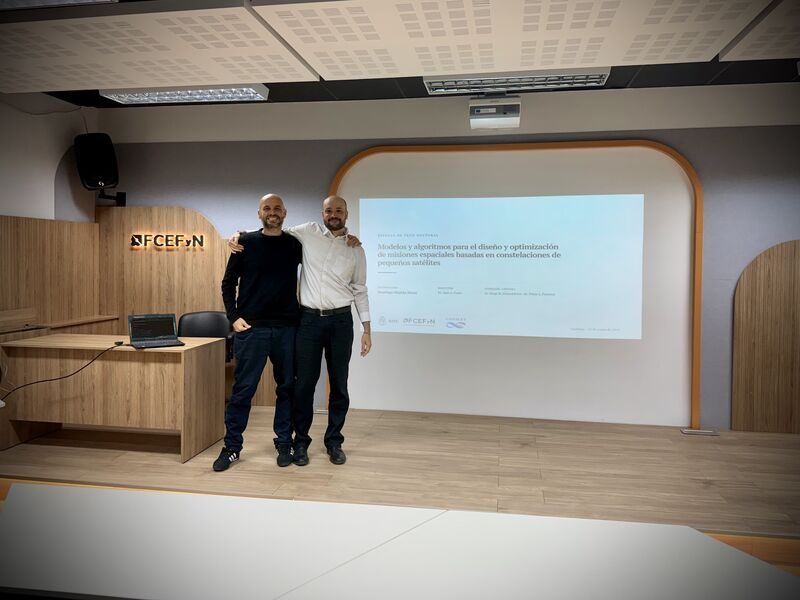
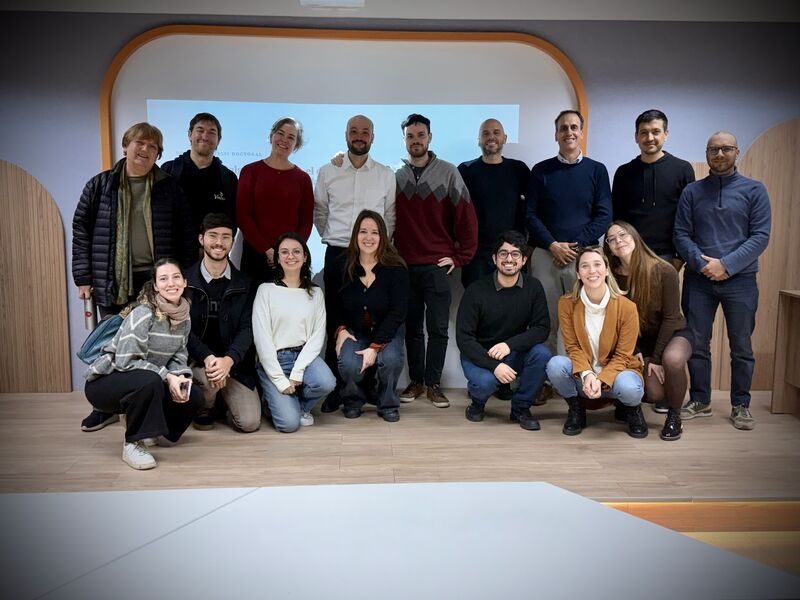
    Title slide of the thesis defence: Modelos y algoritmos para el diseño y optimización de misiones espaciales basadas en constelaciones de pequeños satélites, by Santiago Martín Henn, UNC, Córdoba, 19 June 2026 Santiago Henn presenting, with the logos of partner institutions on the screen Santiago Henn and a colleague in the defence room, beside the projected title slide Group photo of about twenty people in the defence room Santiago Henn seen from behind in a foil hat and a cardboard satellite costume that reads Doctor en órbita

    On LinkedIn

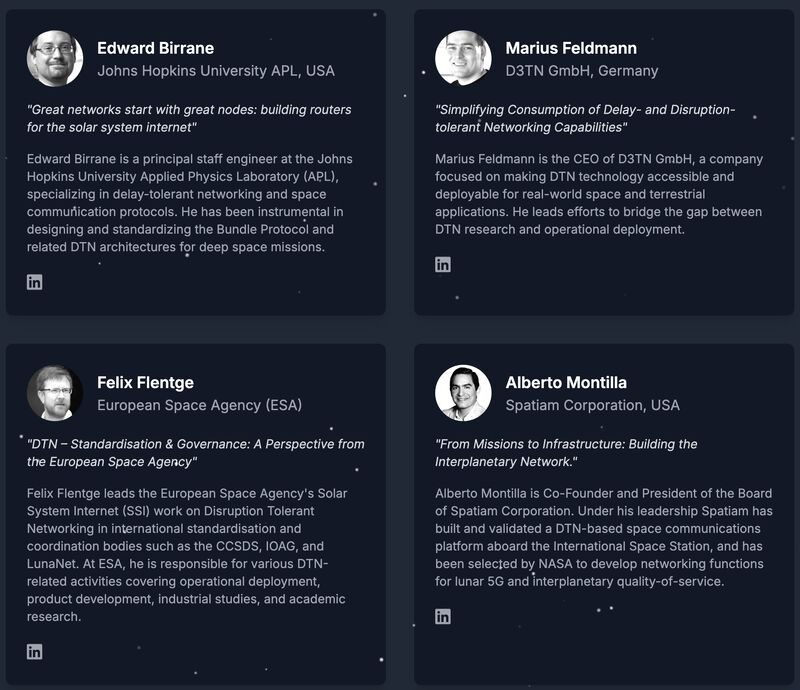
  15. 🚀 Final reminder: submissions for the 2026 Space–Terrestrial Internetworking (STINT) Workshop close on June 15, 2026 — no extension planned. Accepted papers will be published in IEEE Xplore.

    I want to highlight the outstanding keynote lineup we will have at STINT 2026:
    🎤 Edward Birrane (Johns Hopkins APL)
    🎤 Marius Feldmann (D3TN GmbH)
    🎤 Felix Flentge (European Space Agency)
    🎤 Alberto Montilla (Spatiam Corporation)

    Looking forward to the discussions around 🛰️ Space networking, 🌍 DTN, 🔗 Space–terrestrial integration, 📡 Non-terrestrial networks, and the ⚡ Future of the Solar System Internet.

    🌐 STINT 2026 Workshop Website: stintworkshops.org

    STINT 2026 keynote speaker cards with talk titles: Edward Birrane (Johns Hopkins University APL), Marius Feldmann (D3TN GmbH), Felix Flentge (ESA) and Alberto Montilla (Spatiam Corporation)

    On LinkedIn

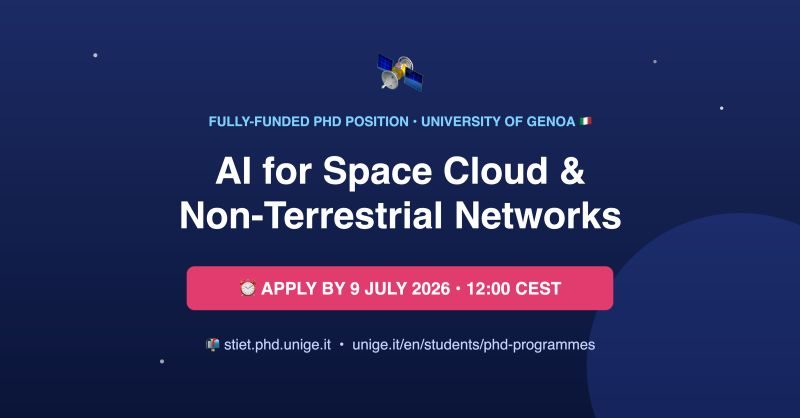
  16. Together with Mario Marchese and Fabio Patrone, we are looking for candidates for a fully funded PhD position — 🛰️ AI for Space Cloud & Non-Terrestrial Networks @ University of Genoa (Italy 🇮🇹)
    📌 Research topic: Design of AI-based communication and computation resource allocation solutions in space cloud architectures for non-terrestrial networks.

    🗓️ Key dates
    • Application deadline: 9 July 2026, 12:00 (CEST)
    • Results: early September 2026
    • PhD start: 1 November 2026

    ✅ Good to know
    • 2–3 reference letters are recommended
    • How to apply: unige.it/en/students/phd-programmes

    📬 Interested? Reach out!

    #PhD #SatelliteCommunications #NonTerrestrialNetworks #6G #EdgeComputing #ArtificialIntelligence #SpaceCloud #LEO #ResearchOpportunity #UniversityOfGenoa #PhDposition

    Announcement of a fully funded PhD position at the University of Genoa: AI for Space Cloud and Non-Terrestrial Networks, apply by 9 July 2026, 12:00 CEST
    On LinkedIn

  17. 🚀 The call for papers for the 2026 Space-Terrestrial Internetworking (STINT) Workshop is now open — submissions due June 15, 2026!

    STINT brings together researchers and practitioners working on:
    🛰️ Space networking
    🌍 Delay/disruption tolerant networking (DTN)
    📡 Satellite and non-terrestrial networks
    🔗 Space-terrestrial integration
    ⚡ Resilient and future Internet architectures

    Accepted papers will be presented at STINT 2026 at KU Leuven, Belgium, and published in IEEE Xplore.

    If you’ve been working on something exciting in this space, now is the time to submit and contribute to the discussion!

    📅 Submission deadline: June 15, 2026
    🔗 stintworkshops.org

    Please share with colleagues, students, and collaborators who may be interested!

    STINT 2026 — Space-Terrestrial Internetworking Workshopstintworkshops.org

    On LinkedIn

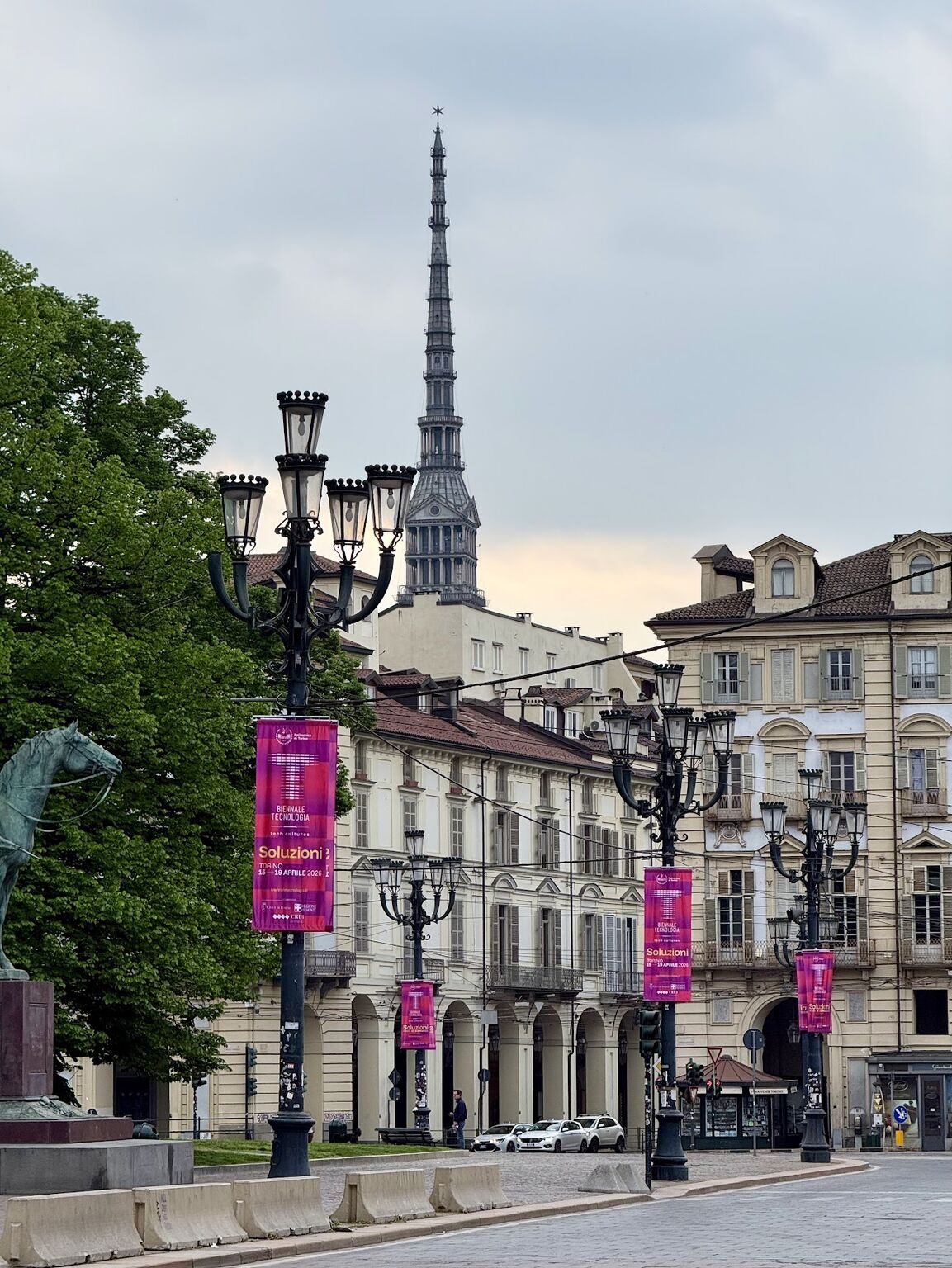
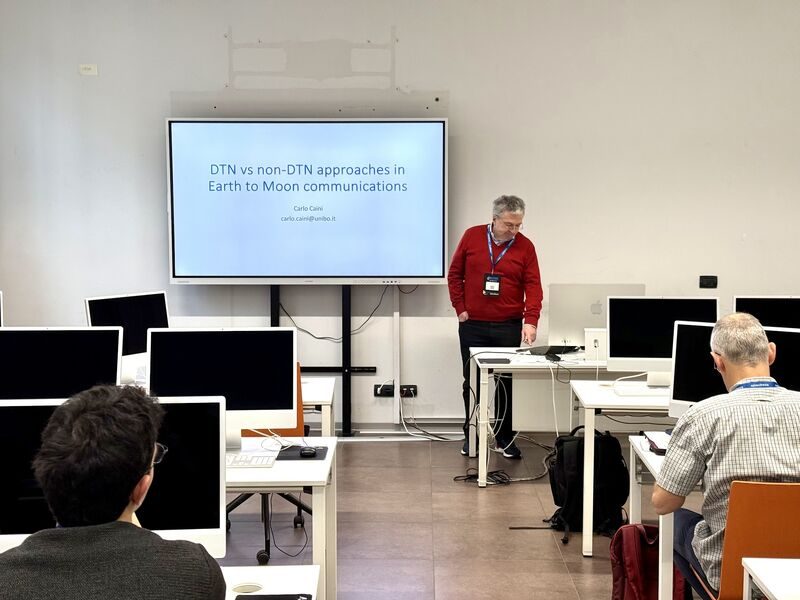
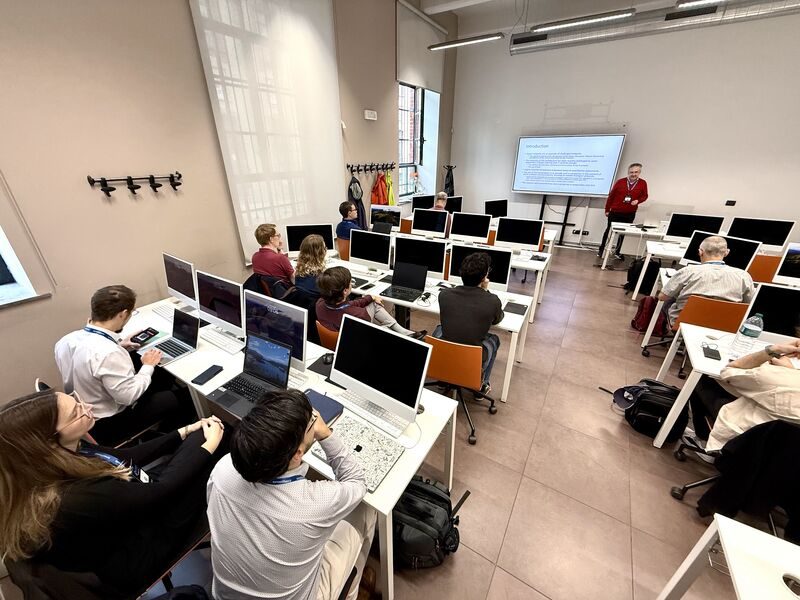
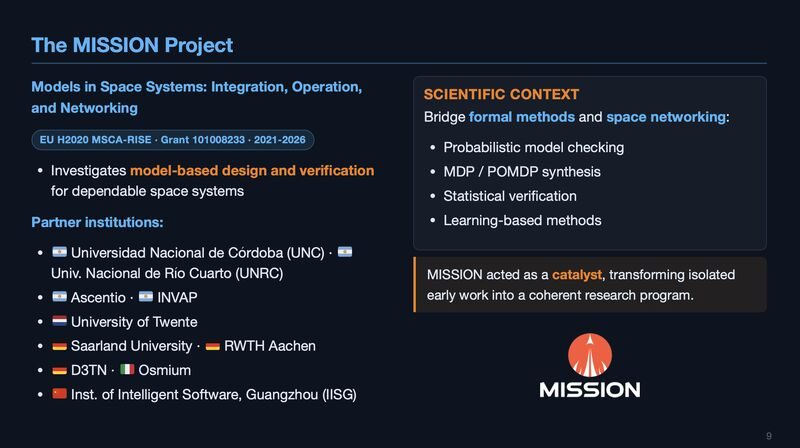
  18. We’ve just wrapped up a fantastic MISSION workshop at ETAPS in Turin, Italy 🚀

    Inspiring talks at the intersection of formal methods 🧩 and space systems 🛰️.

    Curious to learn more❓ Check out the program and feel free to reach out: mission-project.eu/etaps2026

    MISSION project logo: a rocket launching inside an orange circle on a dark navy background Slide on the MISSION project (Models in Space Systems: Integration, Operation, and Networking), EU H2020 MSCA-RISE, 2021-2026, listing partner institutions Turin street with the Mole Antonelliana spire and lamp-post banners for Biennale Tecnologia, Torino, 15-19 April 2026 A speaker beside the title slide DTN vs non-DTN approaches in Earth to Moon communications, by Carlo Caini, in a computer lab Workshop participants at desktop workstations in a computer lab, facing a speaker beside an Introduction slide

    On LinkedIn

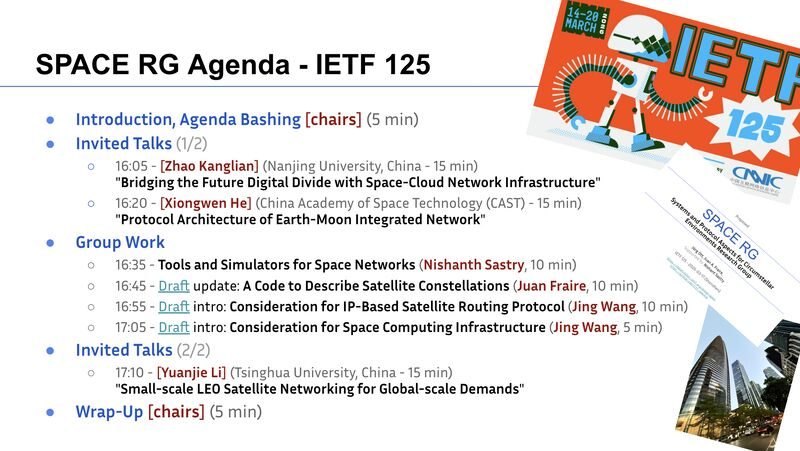
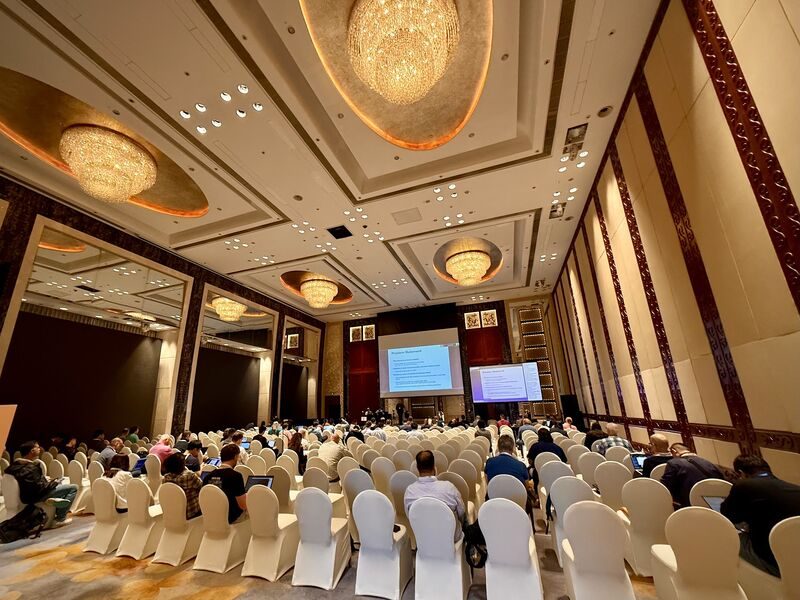
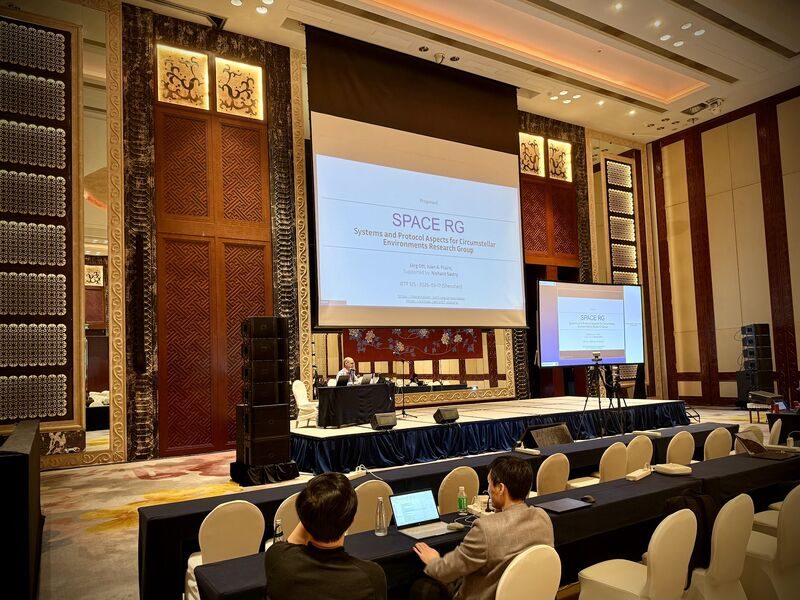
  19. 🚀 Our SPACE Research Group session at IETF 125 has just wrapped up.

    Great discussions on key challenges shaping the future of space networking:
    🛰️ Networking for space data centers
    🌌 Deep-space protocols
    📡 Internet constellation design and operations

    The agenda is attached 👇 and the recording is available here: youtu.be/_8di28XxLBw

    👉 Next stop: IETF 126 in Vienna (July) — don’t miss it.

    More about the SPACE RG: datatracker.ietf.org/rg/space/about

    cc. Jörg Ott & Nishanth Sastry

    #IETF #SpaceNetworking #DTN #Satellite #InternetOfSpace #Research #Aerospace #Networking

    IETF 125 banner: 14-20 March 2026, hosted by CNNIC, with an illustrated robot SPACE RG agenda for IETF 125: invited talks on space-cloud, Earth-Moon and LEO satellite networking, plus group work on tools, simulators and drafts Attendees in rows of white chairs facing two projected slides in a large ballroom with chandeliers SPACE RG title slide on the main screen, Systems and Protocol Aspects for Circumstellar Environments Research Group, with a speaker at the stage table Six attendees with IETF badges giving a thumbs up beside an IETF display

    On LinkedIn

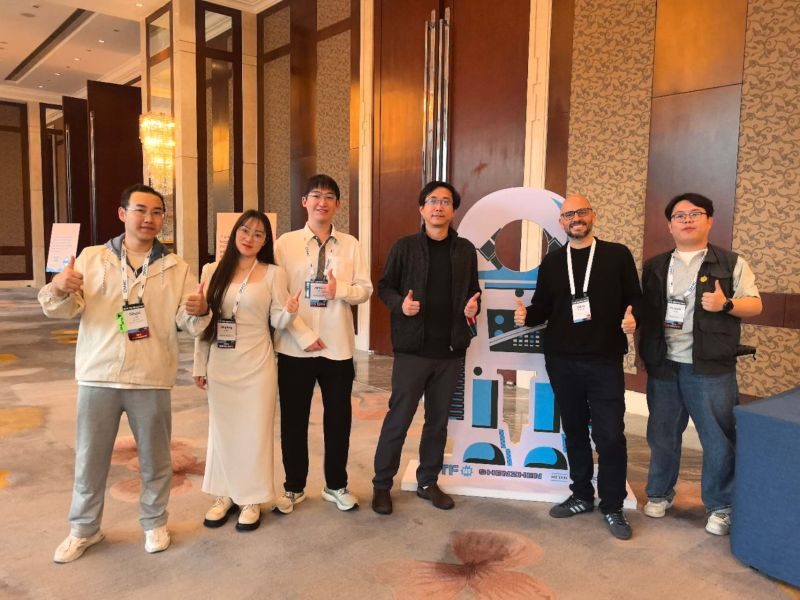
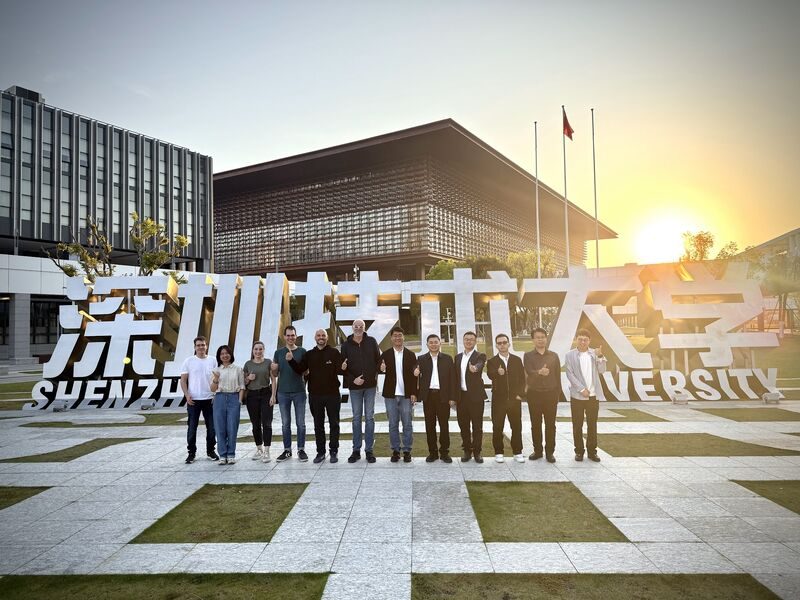
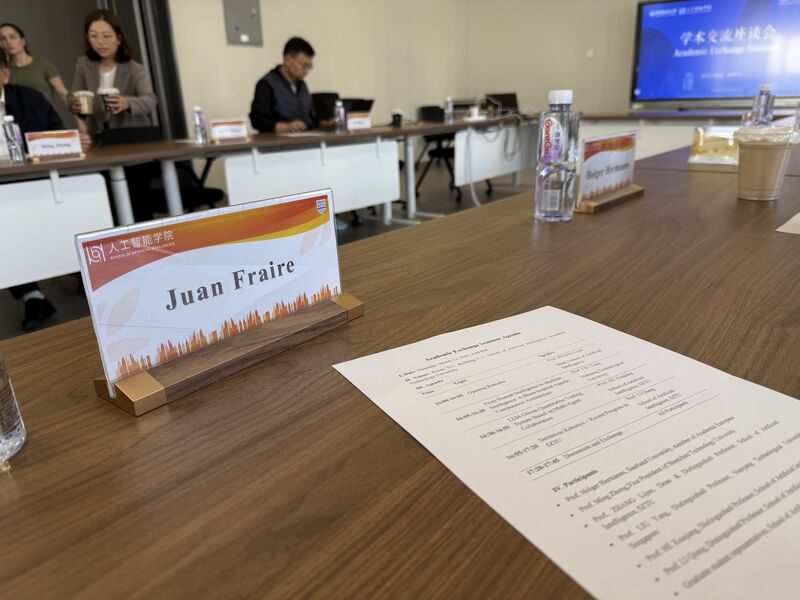
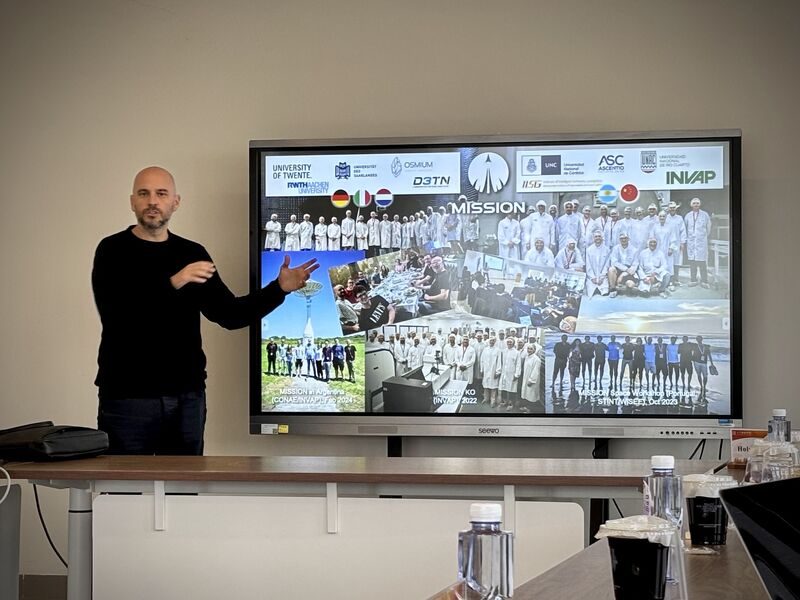
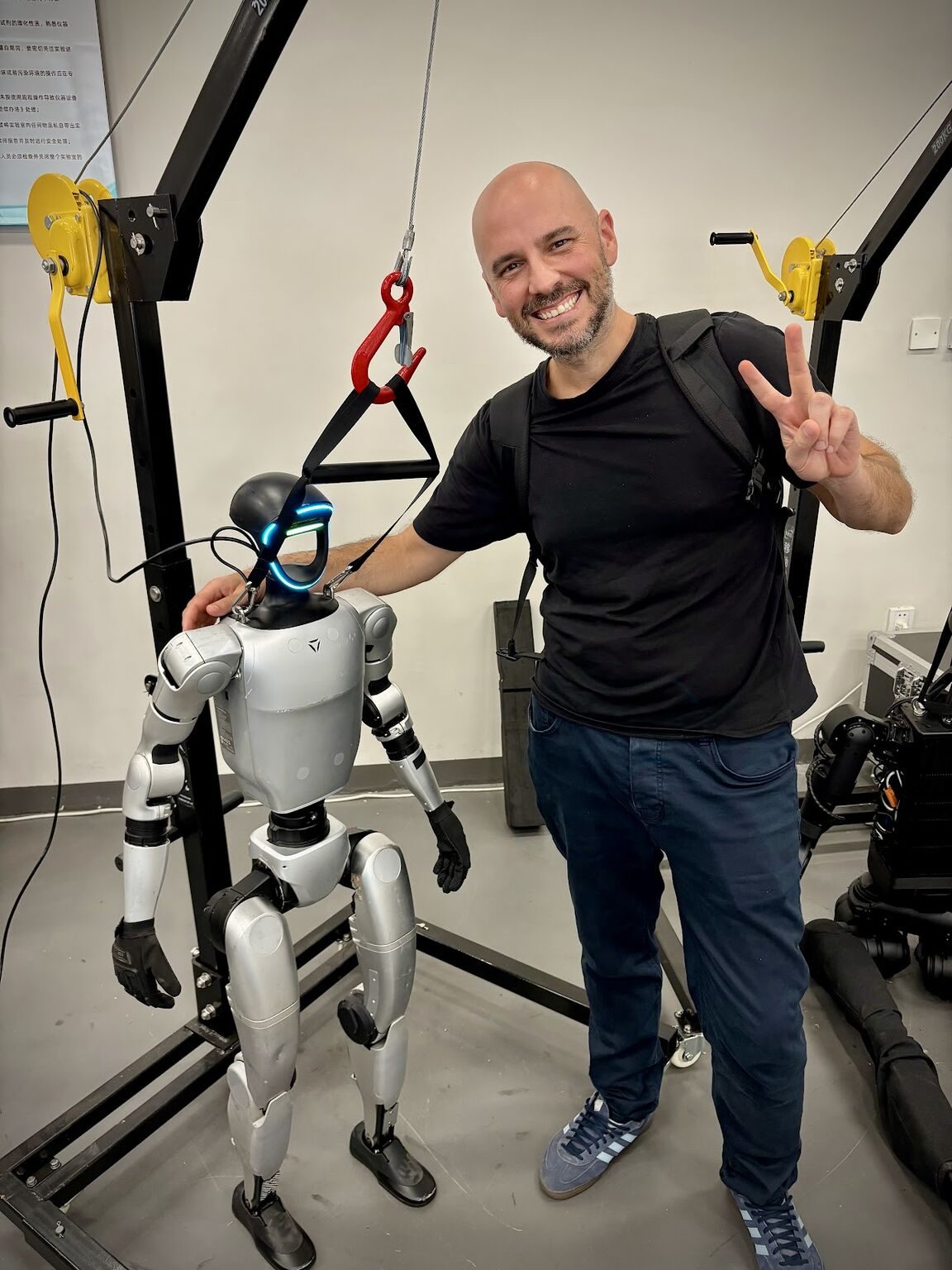
  20. In the context of the MISSION project (mission-project.eu), we had the pleasure of running a workshop at the AI School of Shenzhen Technology University (#SZTU) on March 12th and 13th.

    Great discussions on the role of computer science at the intersection of robotics, AI, and space systems, and the opportunities this convergence opens for future research.

    A big thank you to Lijun Zhang for the excellent organization and for bringing together such an engaged audience!

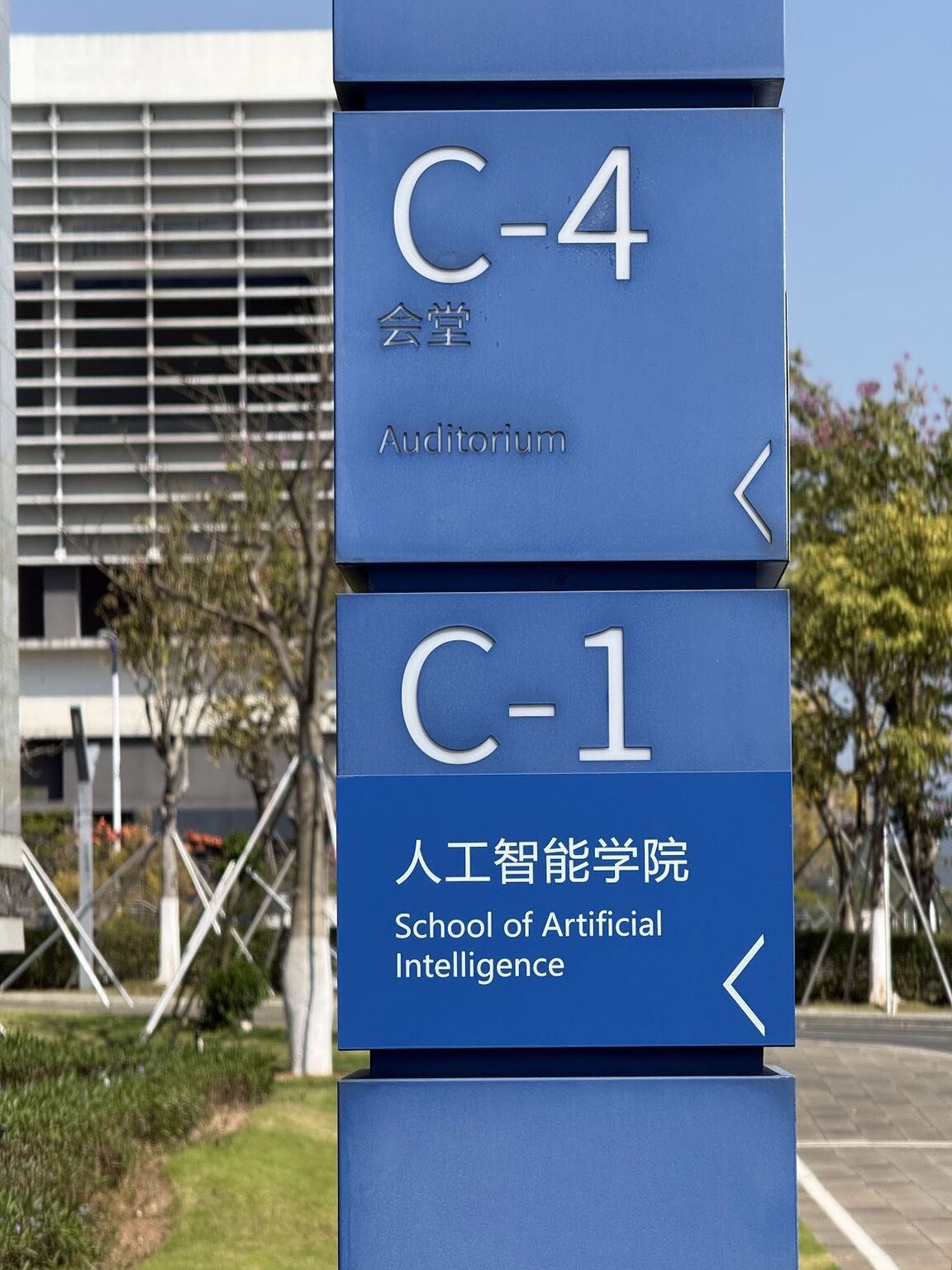
    Group photo of twelve workshop participants in front of the large Shenzhen Technology University lettering at sunset Campus signpost pointing to C-4 Auditorium and C-1 School of Artificial Intelligence, in Chinese and English Name card for Juan Fraire and the Academic Exchange Seminar agenda on a meeting table, with the seminar title on the screen behind A speaker presents a MISSION project slide with partner logos and photos of past project meetings, including teams in cleanroom suits A participant poses with a silver humanoid robot hanging from a support frame in a robotics lab

    On LinkedIn

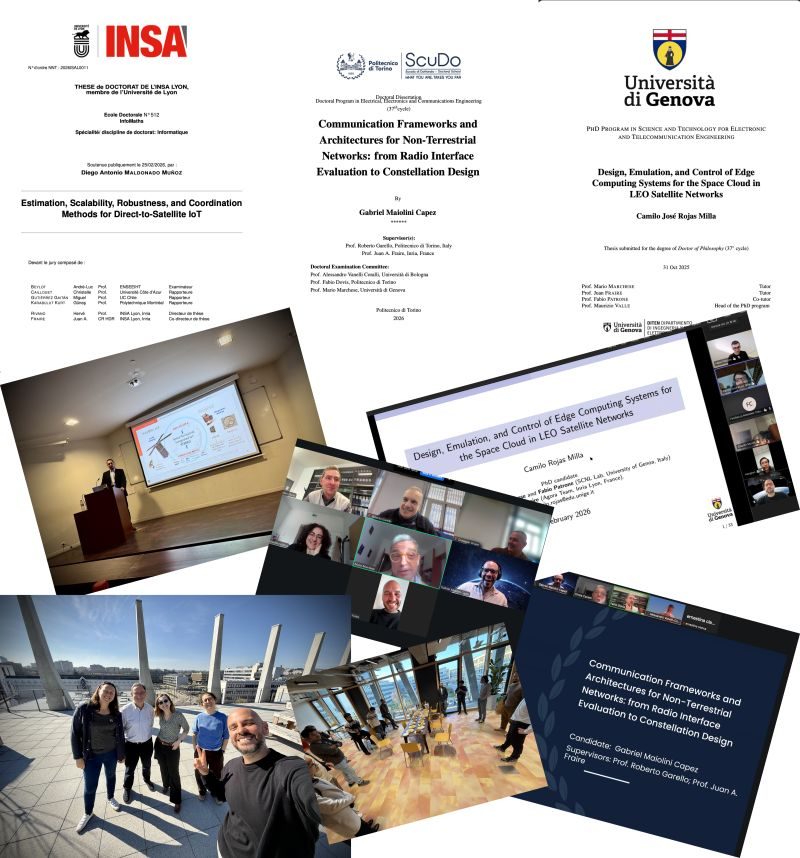
  21. Three PhD defenses in one week 🚀

    I am soooo happy and proud to have co-supervised three outstanding PhD students who successfully defended their theses this week across three different European institutions 🇫🇷🇮🇹.

    1️⃣ Diego Maldonado Munoz
    📍 INSA Lyon, Université de Lyon (France)
    🎓 Estimation, Scalability, Robustness, and Coordination Methods for Direct-to-Satellite IoT
    🤝 Co-supervised with Prof. Hervé Rivano

    2️⃣ Camilo Jose Rojas Milla
    📍 Università di Genova (Italy)
    🎓 Design, Emulation, and Control of Edge Computing Systems for the Space Cloud in LEO Satellite Networks
    🤝 Co-supervised with Prof. Mario Marchese and Prof. Fabio Patrone

    3️⃣ Gabriel Maiolini Capez
    📍 Politecnico di Torino (Italy)
    🎓 Communication Frameworks and Architectures for Non-Terrestrial Networks: from Radio Interface Evaluation to Constellation Design
    🤝 Co-supervised with Prof. Roberto Garello

    Three theses, three institutions, one vision: advancing space and non-terrestrial networks through international collaboration 🌍

    In space, we truly have no frontiers. The challenges are plenty, and tackling them requires strong cross-border cooperation. This week has been a perfect illustration of that spirit.

    Congratulations to my Latin American fellows — Diego, Camilo Rojas Milla, and Gabriel — on this major milestone! 🎉
    It has been a privilege to accompany you on this journey!

    Collage of the three thesis title pages (INSA Lyon, Politecnico di Torino, Università di Genova) with defence photos, video-call screenshots and title slides

    On LinkedIn

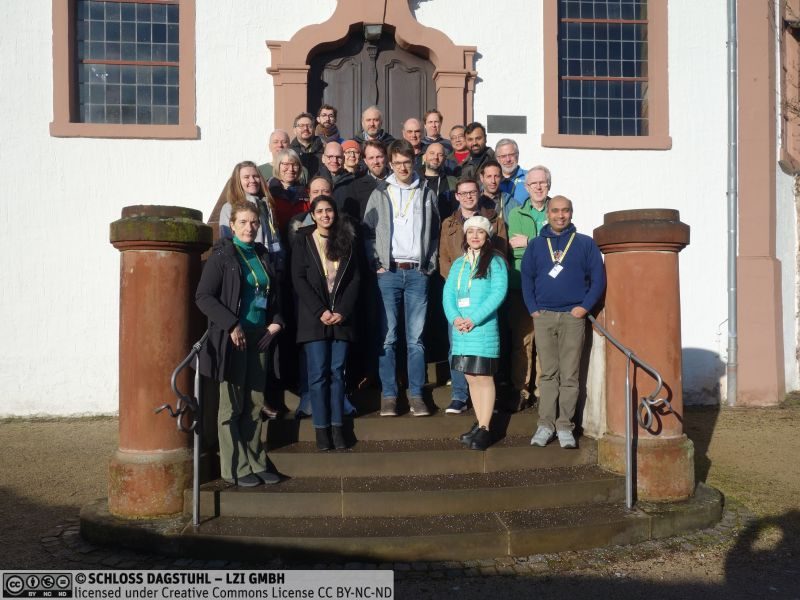
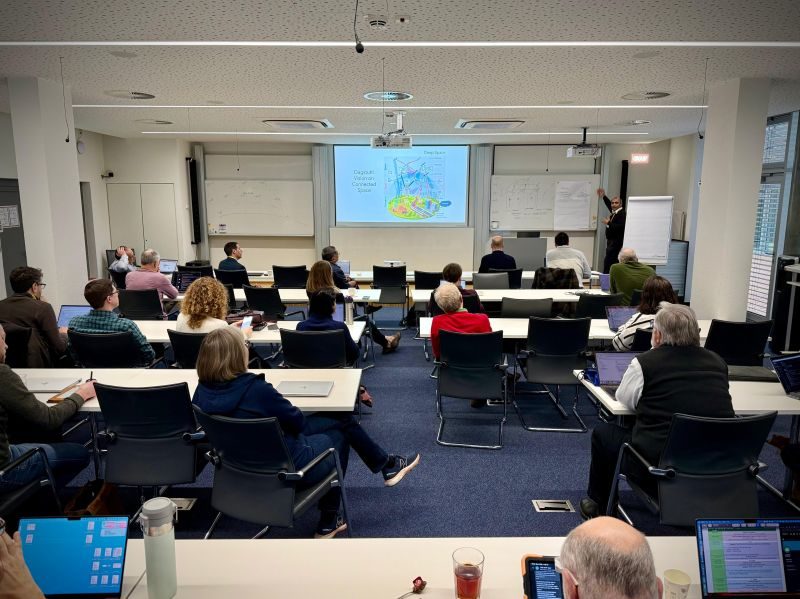
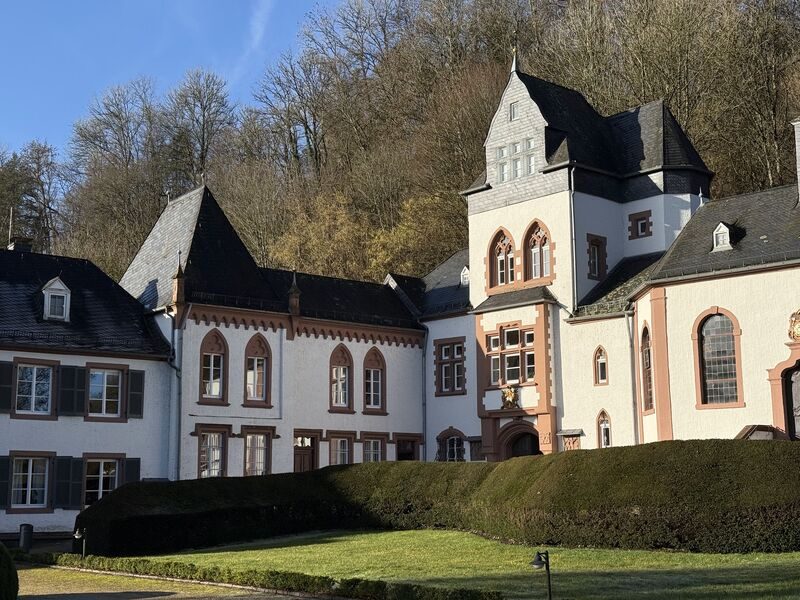
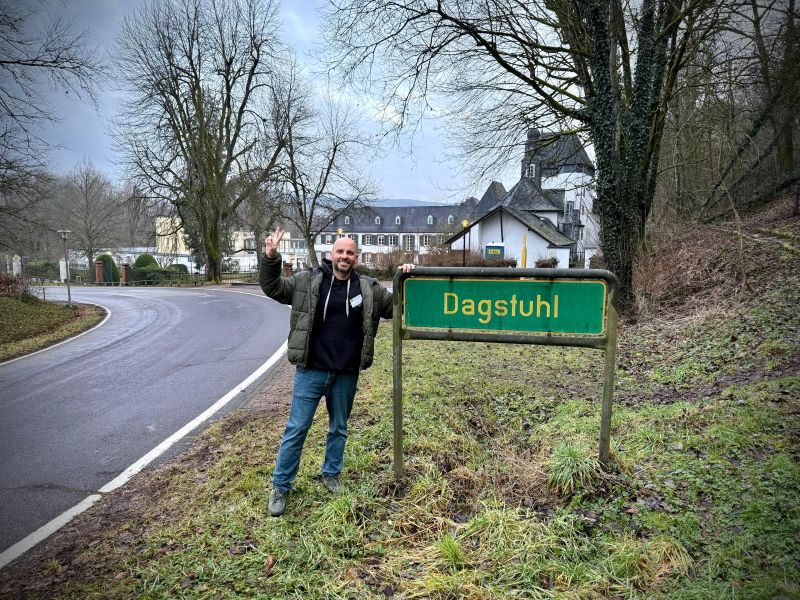
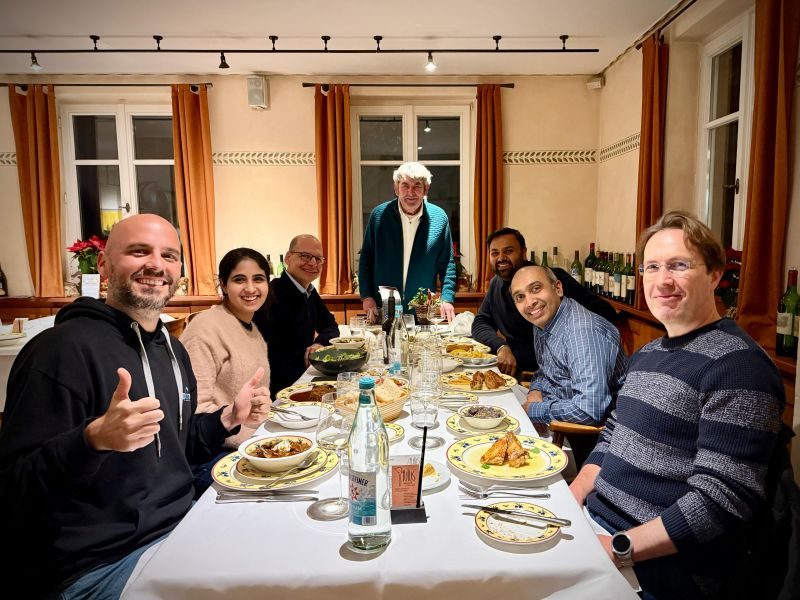
  22. Just back from an inspiring week at Schloss Dagstuhl – Leibniz-Zentrum für Informatik (LZI), where I had the privilege of participating in the “Connected Space” seminar.

    Dagstuhl seminars are indeed truly unique: designed to foster deep technical exchange among leading experts from academia and industry.

    Space is rapidly becoming a computing and networking platform, not just a communications infrastructure. The seminar helped crystallize some of the field’s main future research directions.

    Many thanks to the organizers, Nitinder Mohan, Nishanth Sastry, and Paulo Milheiro Mendes, for bringing together such an outstanding group.

    🔗 dagstuhl.de/seminars/seminar-calendar/se…

    #Dagstuhl #SatelliteNetworking #SpaceComputing #NTN #LEO #Research #Inria

    Group photo of the Connected Space seminar participants on the entrance steps of Schloss Dagstuhl Seminar session in a Dagstuhl meeting room: participants with laptops at desks face a speaker beside a projected slide on connected space The Schloss Dagstuhl buildings, white walls with slate roofs and red sandstone window frames, behind a hedge and lawn under a blue sky A participant giving a peace sign beside the green Dagstuhl town sign, with the Schloss buildings in the background Seven seminar participants around a dinner table set with plates, glasses and water bottles

    On LinkedIn

  23. 🚀 SPACE RG — First Official Meeting at IETF 124 (Montreal)

    Today (Nov 6), we (with Jörg Ott, Nishanth Sastry) held the first official meeting of the IRTF Research Group on SPACE at IETF 124 in Montreal, following two earlier side meetings at IETF 122 and 123.

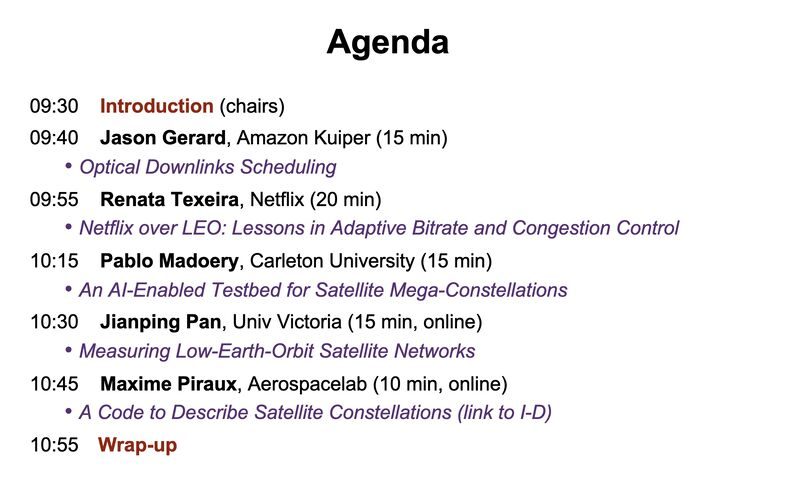
    The turnout: ~90 participants onsite + remote, demonstrating the growing momentum around networking research for LEO mega-constellations, lunar infrastructure, and deep-space systems. Our technical agenda covered:

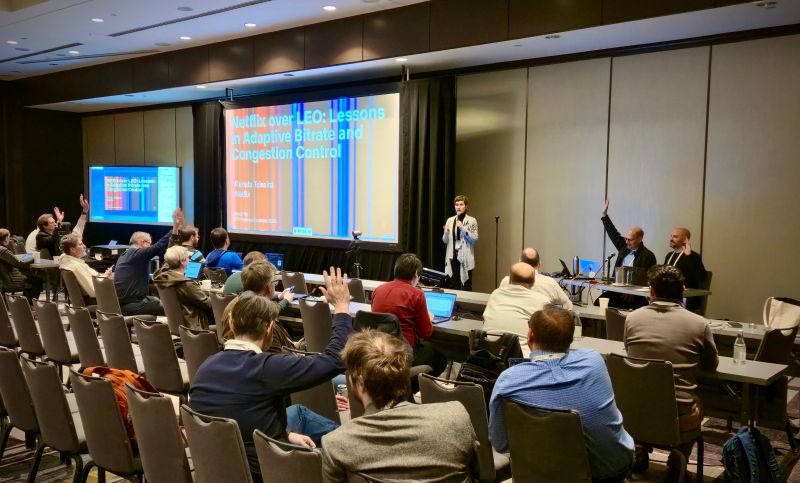
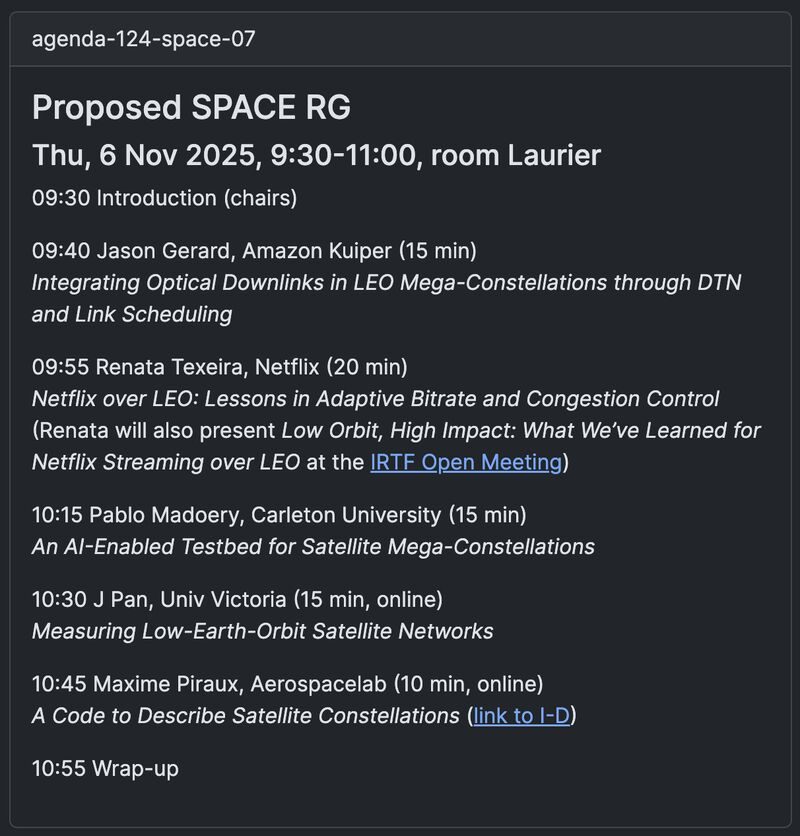
    ✅ Streaming over LEO — Netflix presented lessons learned in adaptive bitrate and congestion control.
    ✅ Laser links & scheduling — Amazon Kuiper discussed the challenges of integrating optical downlinks in mega-constellations.
    ✅ AI-enabled constellations — New tools for simulation, analysis, and testbeds.
    ✅ Real-world measurements — Live results on end-to-end performance across operational LEO systems.
    ✅ New drafts — A proposed framework to simplify constellation classification and enumeration.

    Beyond our own work, SPACE RG aims to feed and collaborate with other groups across the IETF/IRTF ecosystem — including DTN, TIPTOP, and TVR — to help align architectures, metrics, and protocol evolution 🌍🛰️📡.

    If you’re interested in contributing to the research agenda, join us:

    🔗 SPACE RG page: datatracker.ietf.org/rg/space/about
    🔗 Mailing list: mailman3.irtf.org/mailman3/lists/space.i…
    🔗 Meeting materials (IETF 124): datatracker.ietf.org/meeting/124/session…

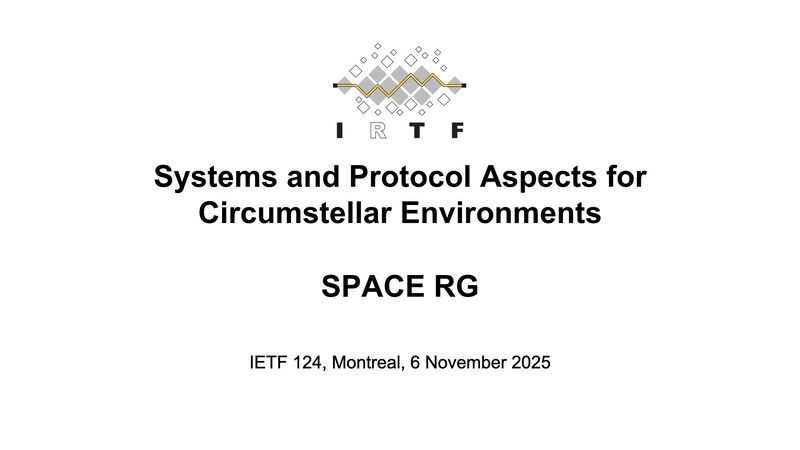
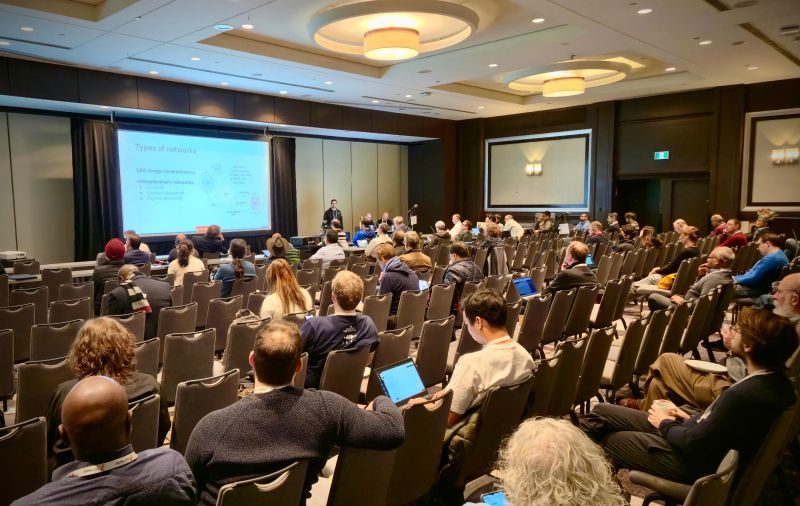
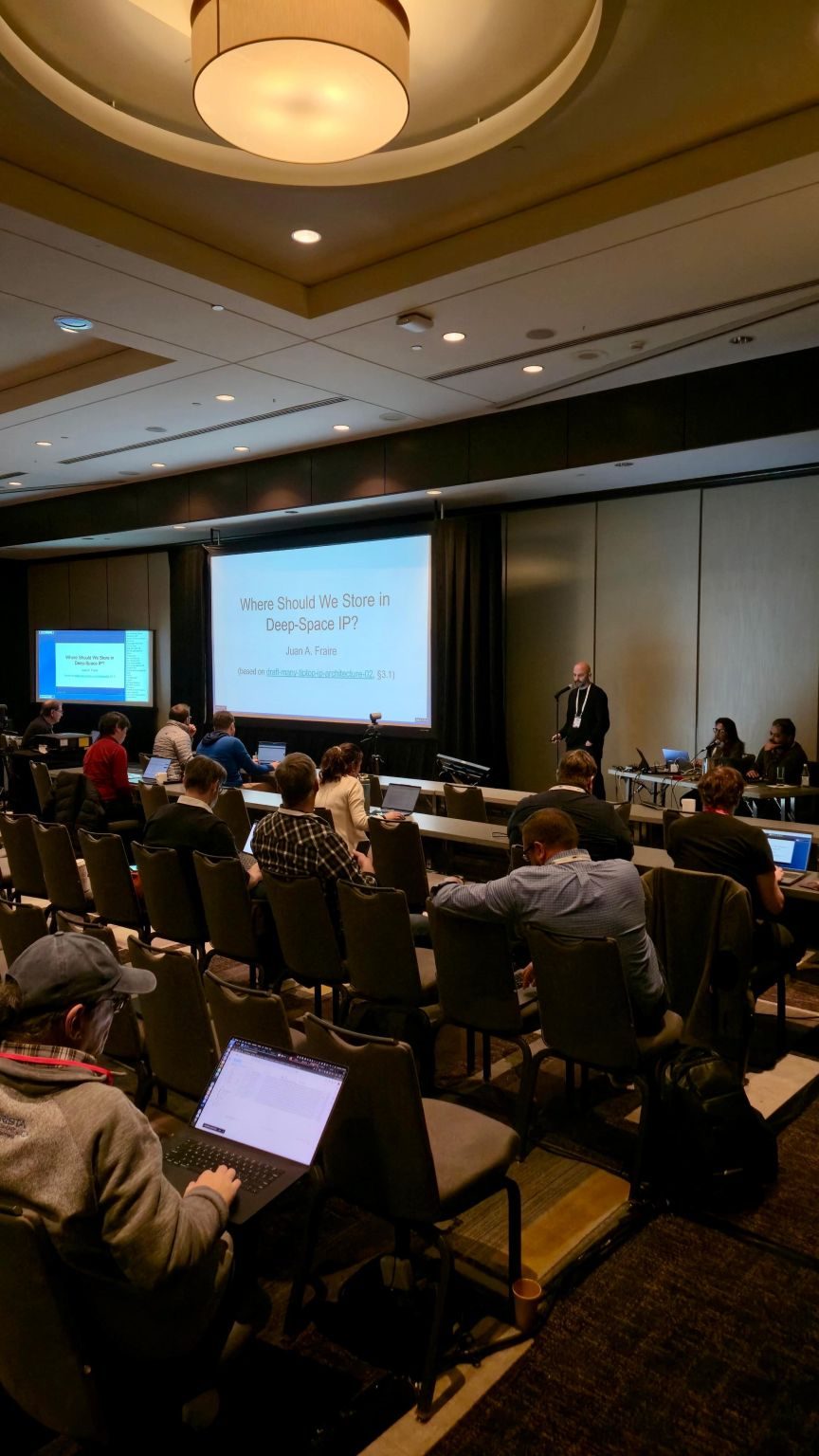
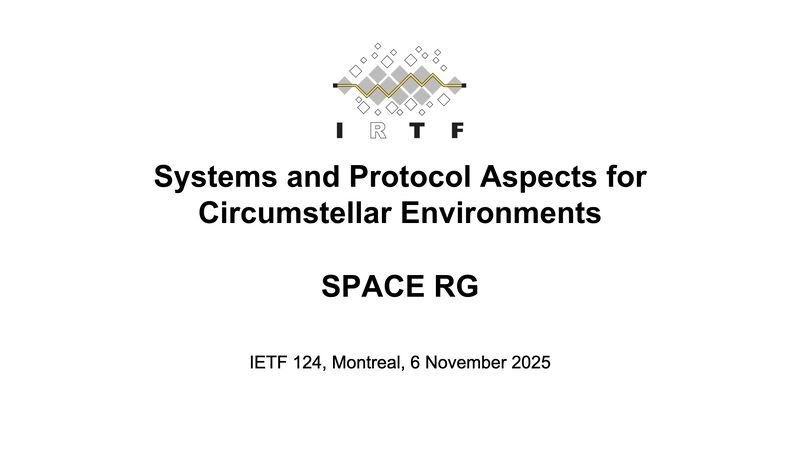
    Title slide: Systems and Protocol Aspects for Circumstellar Environments, SPACE RG, IETF 124, Montreal, 6 November 2025 Agenda slide: talks by Jason Gerard (Amazon Kuiper), Renata Teixeira (Netflix), Pablo Madoery (Carleton University), Jianping Pan (Univ Victoria) and Maxime Piraux (Aerospacelab) A full meeting room during the SPACE RG session, with a speaker at the front presenting a slide titled Types of networks Netflix over LEO talk by Renata Teixeira (Netflix): the speaker at the front of the room as several participants raise their hands Talk by Juan A. Fraire, Where Should We Store in Deep-Space IP?, with the speaker at the microphone and participants working on laptops

    On LinkedIn

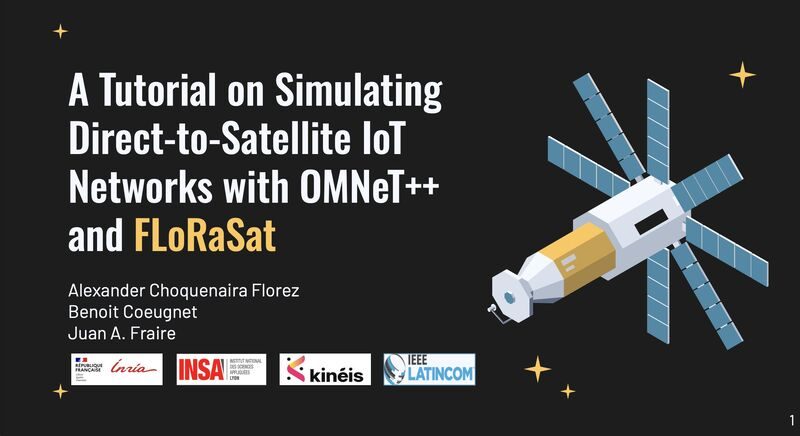
  24. 🎓 A Tutorial on Simulating Direct-to-Satellite IoT Networks with OMNeT++ and FLoRaSat 🚀

    Proud to share that my PhD student, Alexander Ylnner Choquenaira Florez (Inria), with the support of Benoit Coeugnet (my PhD at Kinéis), presented our tutorial at the IEEE LatinCom 2025 in Antigua, Guatemala 🇬🇹 (5–7 November).

    The session introduced FLoRaSat, our open-source simulator for Direct-to-Satellite IoT networks, and demonstrated its integration with OMNeT++ for large-scale experiments.

    📺 Watch the tutorial video here: youtu.be/cdZtY82nTqA

    #SatelliteIoT #OMNeTpp #FLoRaSat #NonTerrestrialNetworks #Inria #Kineis #LatinCom2025

    Title slide: A Tutorial on Simulating Direct-to-Satellite IoT Networks with OMNeT++ and FLoRaSat, by Alexander Choquenaira Florez, Benoit Coeugnet and Juan A. Fraire

    On LinkedIn

  25. 🚀 IETF 124 is underway in Montreal!

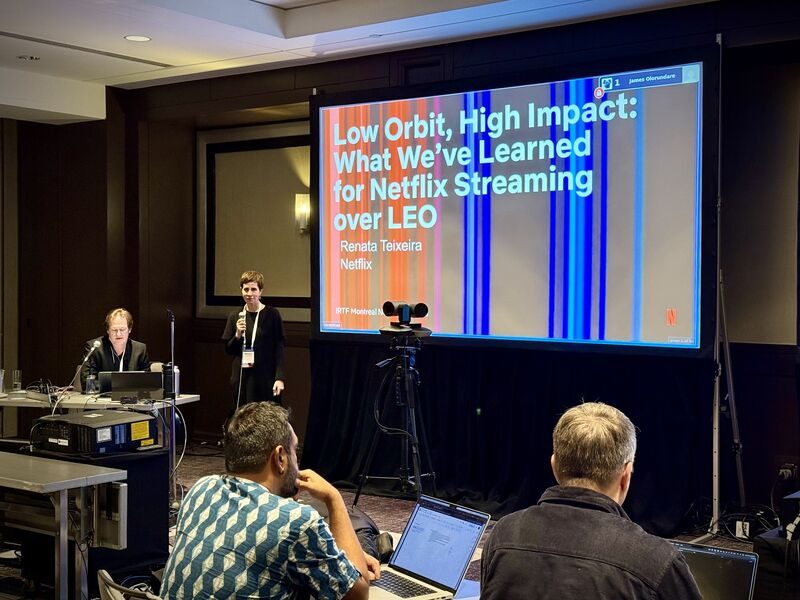
    🛜 At the IRTF Open Meeting, Renata Teixeira from Netflix kicked off the week with a fascinating keynote, sparking great discussions on how low-Earth-orbit (LEO) constellations are reshaping end-to-end data delivery — including streaming and congestion control across space networks.

    🎙️ The conversation continues at our upcoming SPACE RG (Systems and Protocol Aspects for Circumstellar Environments) session this Thursday, November 6, from 9:30–11:00 AM (room Laurier).

    🛰️ Check out the full agenda here:
    👉 datatracker.ietf.org/doc/agenda-124-space

    🌐 More about the SPACE RG:
    👉 datatracker.ietf.org/group/space/about

    If you’re at IETF 124 — come join us for this exciting discussion on the future of space-terrestrial networking!

    #IETF124 #IRTF #SpaceNetworking #NonTerrestrialNetworks #LEO #SatelliteInternet #DTN #SpaceRG

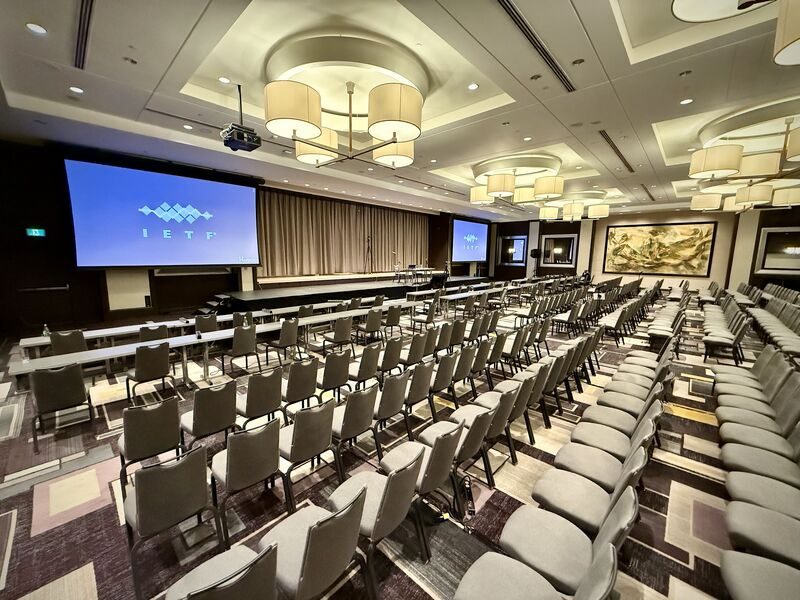
    IRTF Open Meeting keynote by Renata Teixeira (Netflix), Low Orbit, High Impact: What We've Learned for Netflix Streaming over LEO, with the speaker beside the screen An empty IETF 124 meeting room with rows of chairs and two screens showing the IETF logo Title slide: Systems and Protocol Aspects for Circumstellar Environments, SPACE RG, IETF 124, Montreal, 6 November 2025 Agenda of the proposed SPACE RG, Thursday 6 November 2025, 9:30 to 11:00, room Laurier, with talks from Amazon Kuiper, Netflix, Carleton University, Univ Victoria and Aerospacelab

    On LinkedIn

  26. 🚀 STINT 2025 is about to start!
    The Space–Terrestrial Internetworking Workshop — the forum for Delay-Tolerant and Space Networking research — is kicking off today in Halifax, Canada, co-located with IEEE WiSEE 2025 🌍✨

    Join us on-site or remotely to discuss the future of interplanetary and non-terrestrial networking!

    📅 October 13–15, 2025
    📍 Halifax, NS, Canada
    💻 Hybrid Access Available

    👉 stintworkshops.org

    #STINT2025 #SpaceNetworking #DelayTolerantNetworking #NonTerrestrialNetworks #WiSEE2025

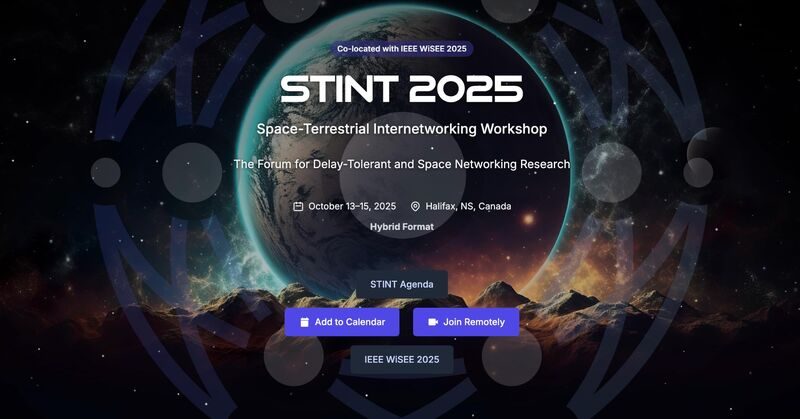
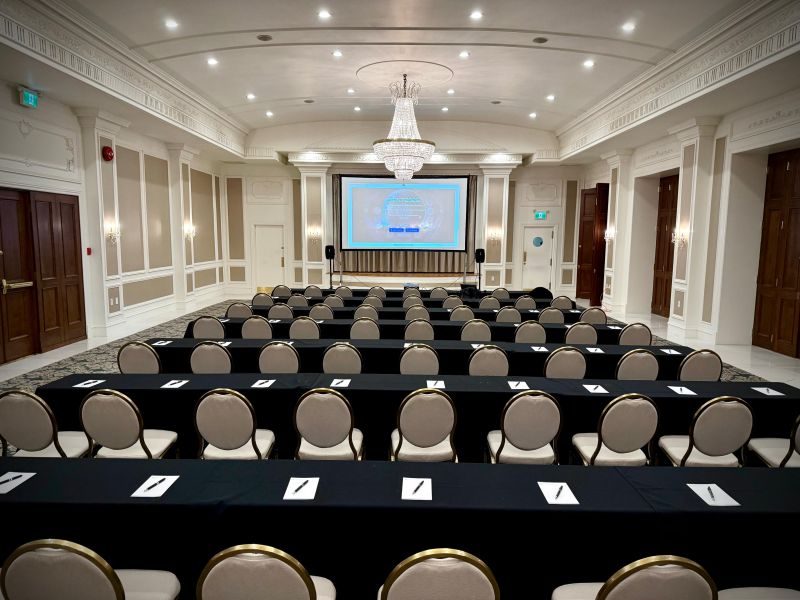
    STINT 2025 banner: Space-Terrestrial Internetworking Workshop, October 13 to 15, 2025, Halifax, NS, Canada, hybrid format, co-located with IEEE WiSEE 2025 The empty workshop room set up for STINT 2025, with rows of tables and notepads, a chandelier and a projection screen at the front

    On LinkedIn

  27. 🚀 NTN Days 2025 was a success!

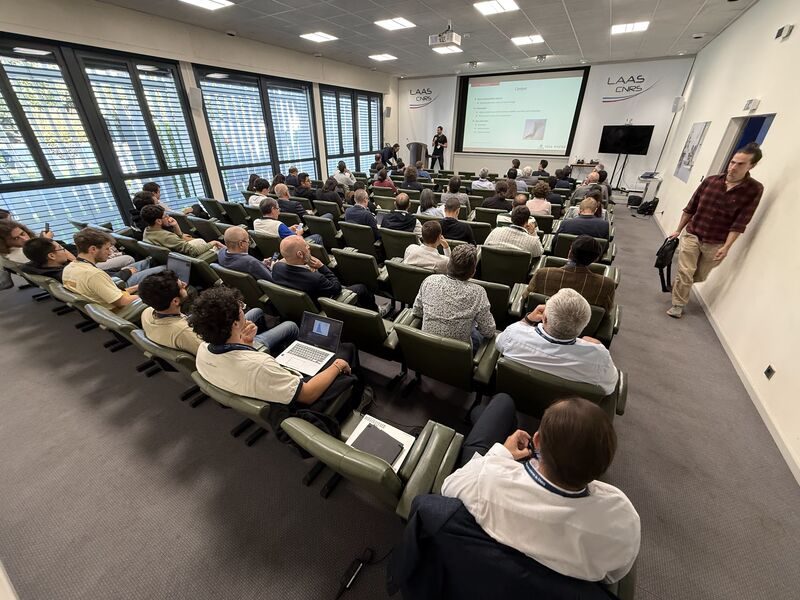
    More than 70 participants gathered at LAAS-CNRS in Toulouse, bringing together industry leaders and top researchers shaping the future of Non-Terrestrial Networks (NTN).

    Highlights included insightful talks from Ericsson, Thales Alenia Space, Kinéis, and leading academics from institutions across France.

    Missed it this year? Don’t worry — we’ll be back! Stay tuned for NTN Days 2026 in Paris 🇫🇷 - More info: ntndays.space

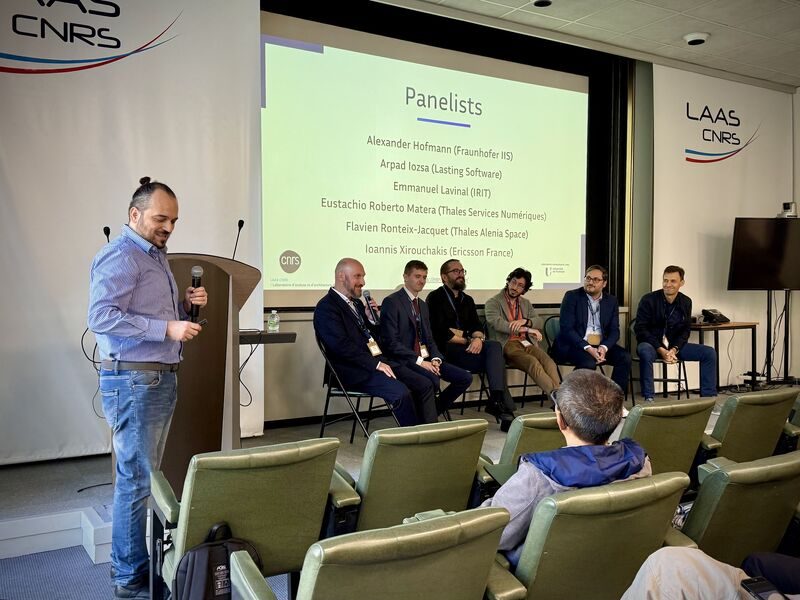
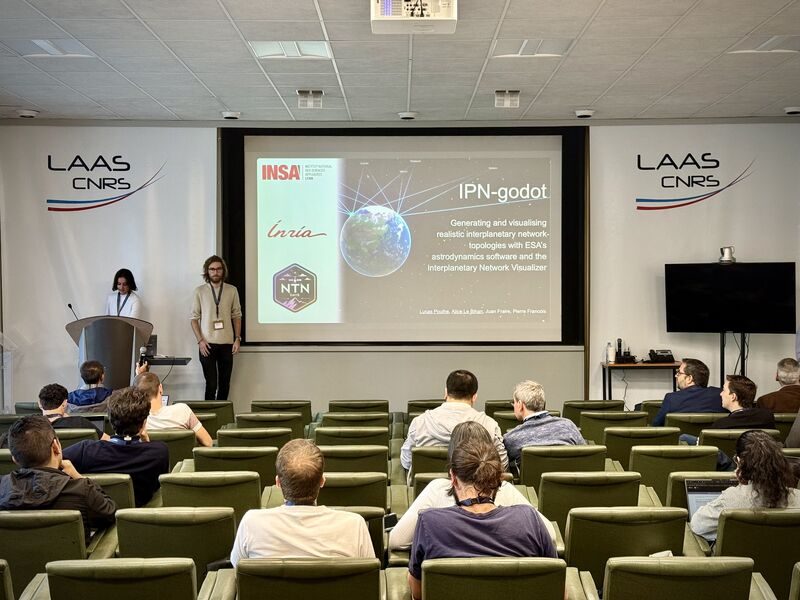
    Participants filling the LAAS-CNRS lecture hall in Toulouse during a talk at NTN Days 2025 Panel session: a moderator at the lectern and six panellists seated beneath a slide listing them, from Fraunhofer IIS, Lasting Software, IRIT, Thales Services Numériques, Thales Alenia Space and Ericsson France Two presenters beside the title slide of IPN-godot, a tool for generating and visualising realistic interplanetary network topologies with ESA's astrodynamics software

    On LinkedIn

  28. SPACE RG @ IETF Madrid: packed room, strong signal 🚀

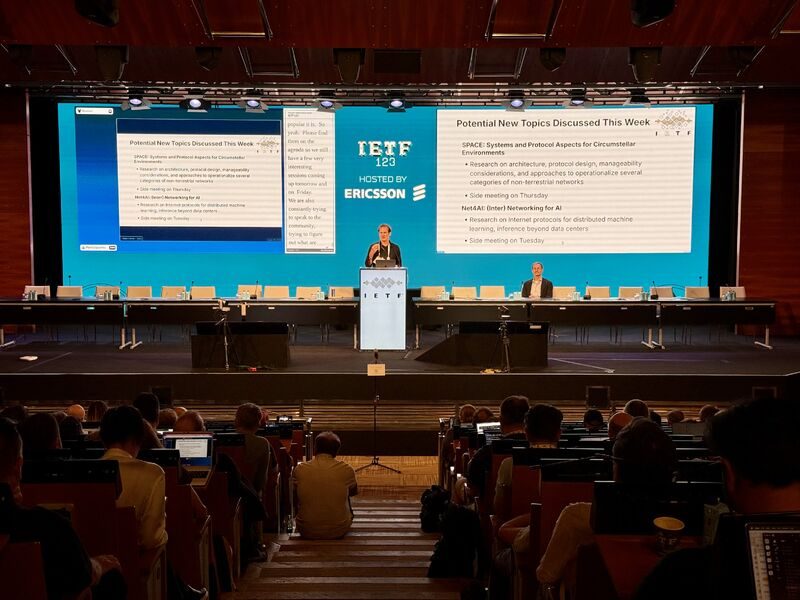
    Last week, we ran the second side‑meeting for the (proposed) IRTF SPACE RG — and it was a clear success: ~60 people on‑site + several 10s remote, spanning space agencies, industry, and academia. The key takeaway: interest in space networking at the IETF/IRTF is strong!

    🛰️What SPACE RG is about (in one line):
    Systems and protocol adaptations for aerospace networks — from HAPS and LEO/MEO/GEO to cislunar and beyond — where mobility, partitions, and constrained resources challenge terrestrial assumptions.

    🎯Our initial goals:
    Build an open data repository for aerospace networks, define reproducible evaluation methodologies, establish best practices and reference scenarios, and foster shared measurement infrastructures.

    👉 Join us / Stay in the loop
    Subscribe: mailman3.irtf.org/mailman3/lists/space.i…
    Repository & materials: github.com/irtf-spacerg

    Proposed co-chairs: Juan Andrés Fraire & Jörg Ott (with support from Nishanth Sastry).

    #IETF #IRTF #SPACE_RG #AerospaceNetworks #NonTerrestrialNetworks #SatCom #HAPS #LEO #Cislunar #DTN #6G #NetworkingResearch #Reproducibility #OpenData

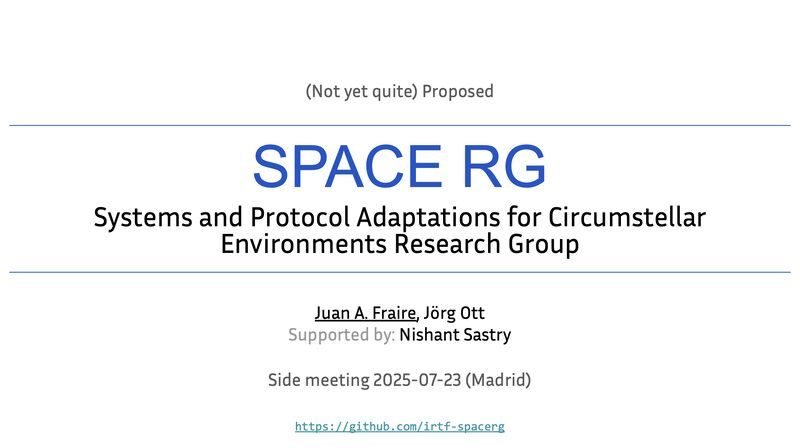
    IETF 123 plenary hall, hosted by Ericsson: a speaker at the lectern before a slide listing SPACE among potential new topics, with a side meeting on Thursday Title slide of the (not yet quite) proposed SPACE RG: Systems and Protocol Adaptations for Circumstellar Environments Research Group, Juan A. Fraire and Jörg Ott, side meeting 2025-07-23, Madrid

    On LinkedIn

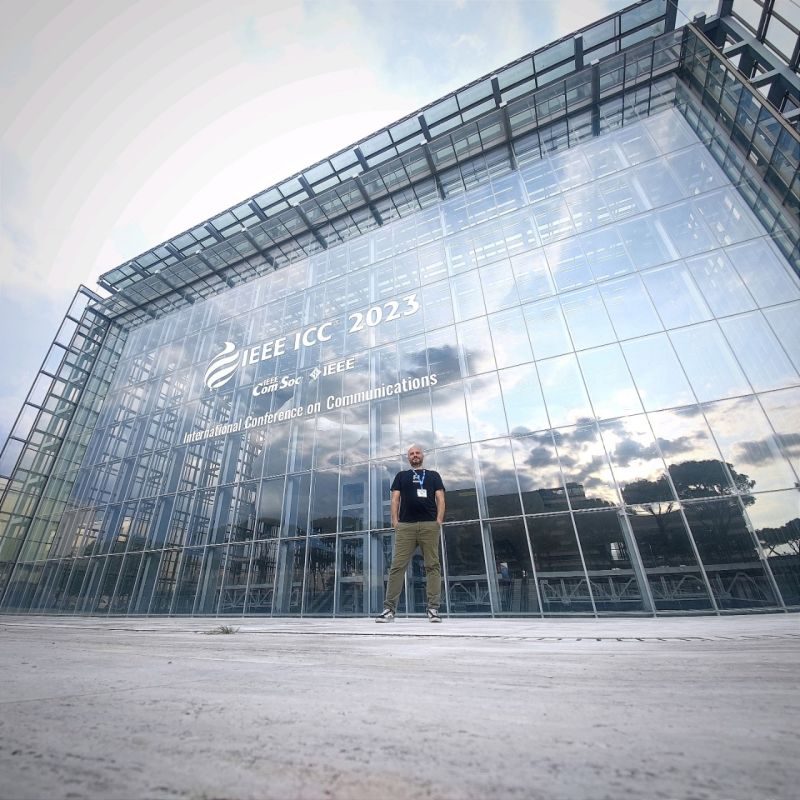
  29. At the always amazing #IEEE #ICC conference in Rome.

    An attendee with a badge standing before the glass facade of the venue, marked IEEE ICC 2023 International Conference on Communications

    On LinkedIn

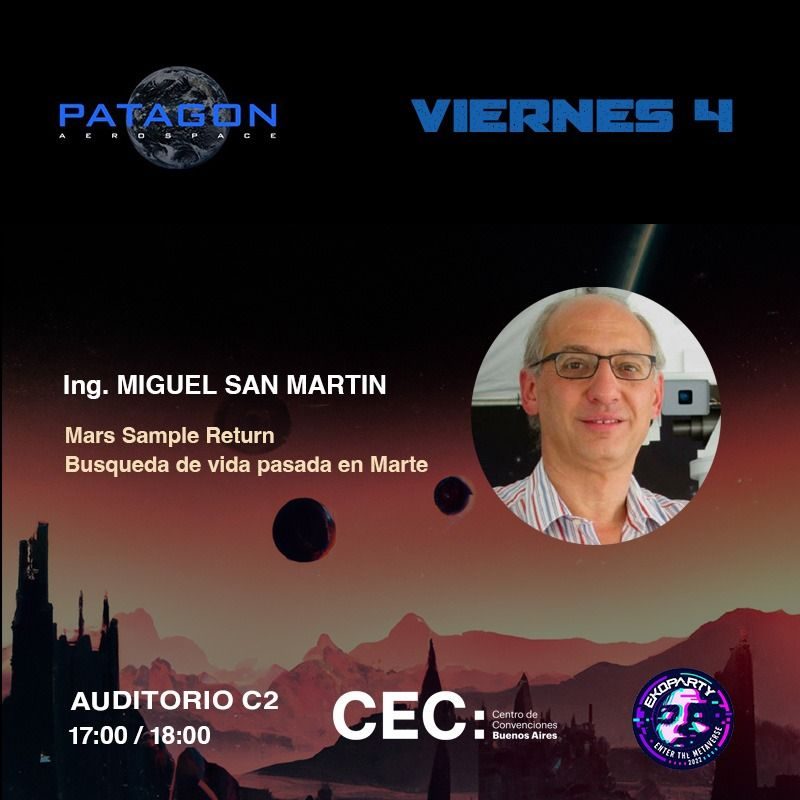
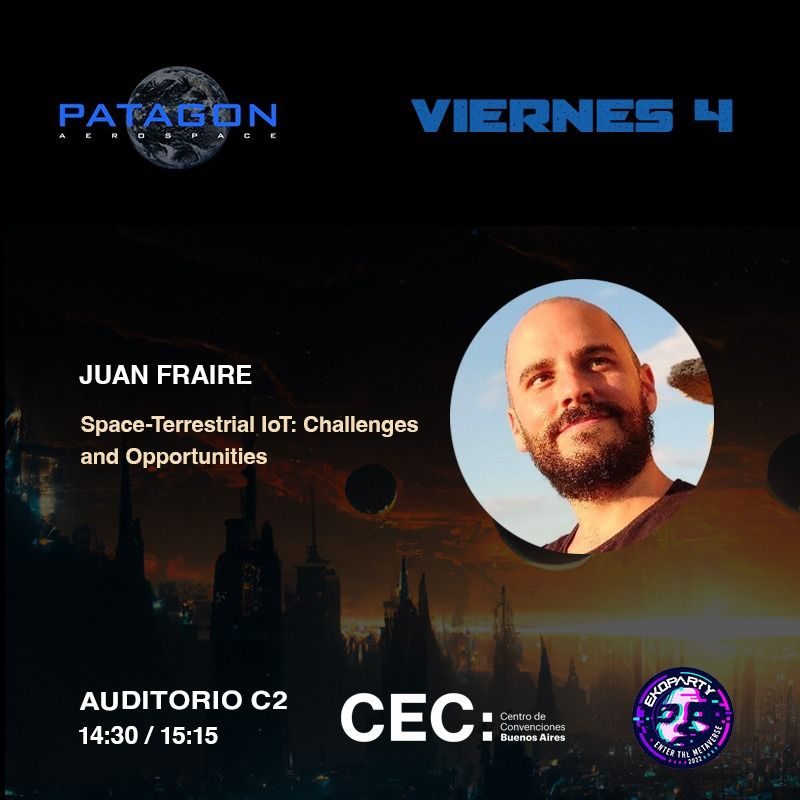
  30. Proudly sharing the stage with A. Miguel San Martin at the Ekoparty Security Conference today!

    Ekoparty speaker card: Ing. Miguel San Martin, Mars Sample Return, Friday 4, Auditorio C2, 17:00 / 18:00 Ekoparty speaker card: Juan Fraire, Space-Terrestrial IoT: Challenges and Opportunities, Friday 4, Auditorio C2, 14:30 / 15:15

    On LinkedIn

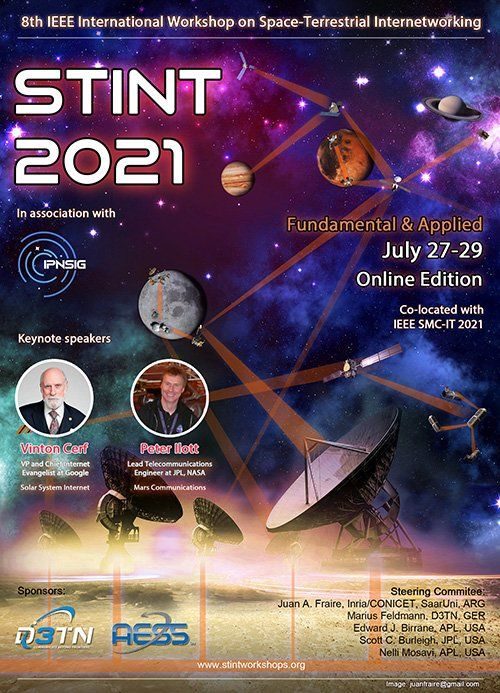
  31. The STINT workshop is shaping up. Vinton Cerf vint cerf, VP Internet Evangelist at Google joins as keynote this year. Don't miss it. Paper deadline March 15th! stintworkshops.org

    STINT 2021 poster: 8th IEEE Space-Terrestrial Internetworking Workshop, July 27-29, online edition, keynotes by Vinton Cerf and Peter Ilott

    On LinkedIn

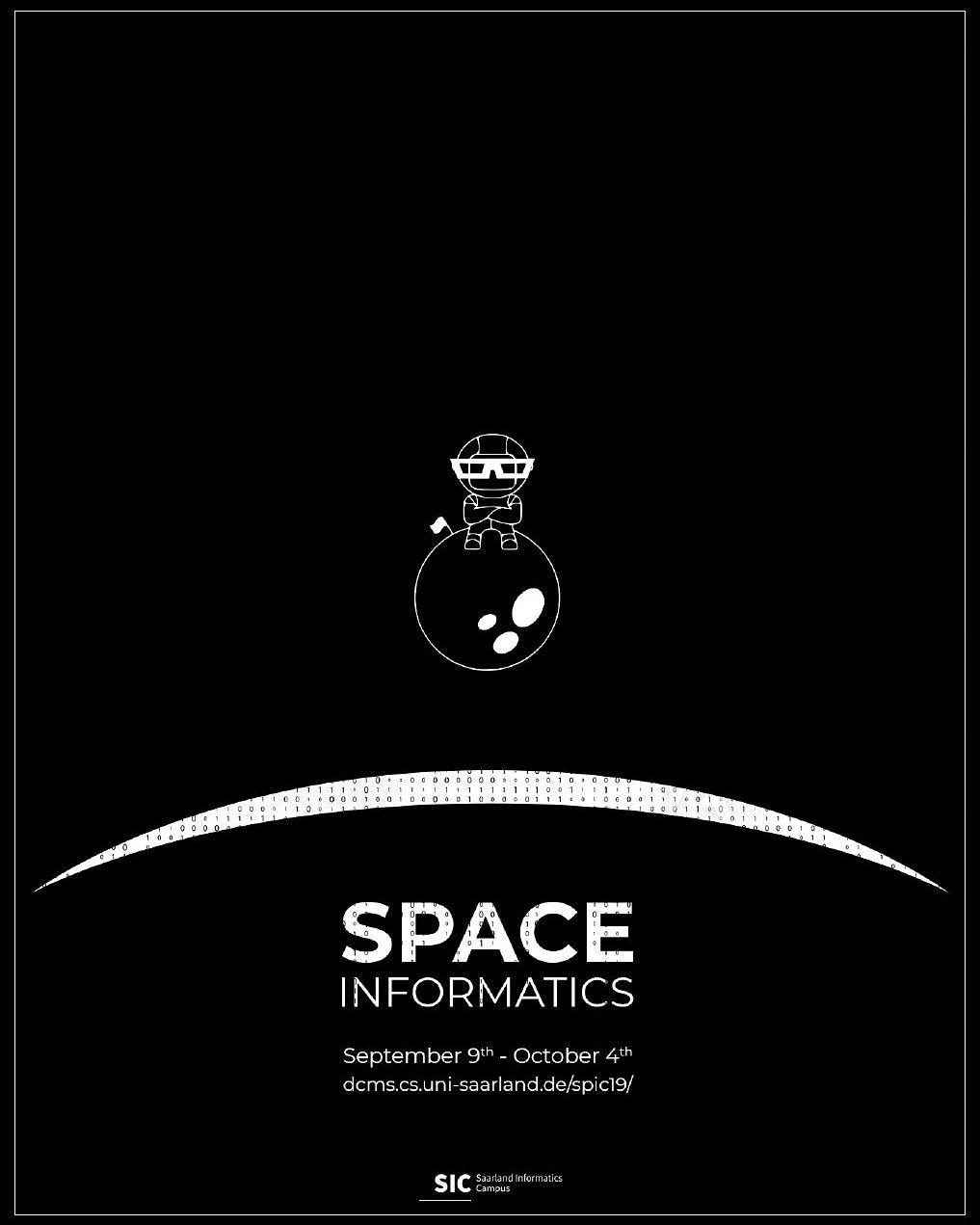
  32. Lecturing on #SpaceInformatics - our block course happening now at Saarland University, Saarbruecken.

    Space Informatics course poster, September 9th - October 4th, Saarland Informatics Campus: a cartoon astronaut sitting on a small moon above Earth

    On LinkedIn

  33. Great discussions on space networking routing and contact planning at @smcit_conf, Pasadena, California!

    On LinkedIn

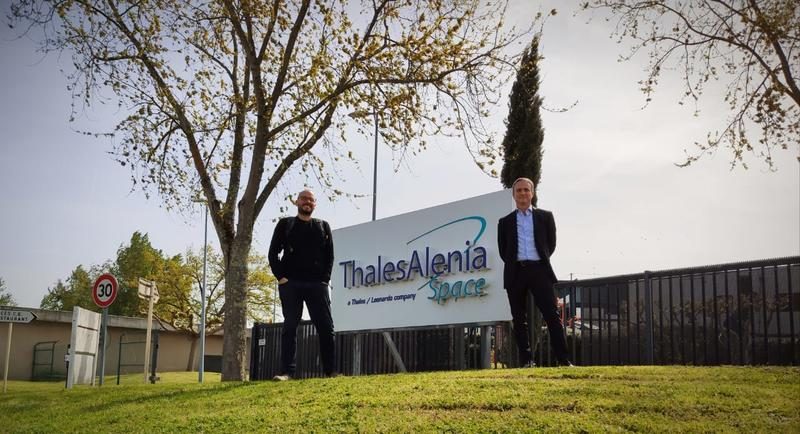
  34. Today with Andres Rodriguez we pitched Skyloom Global in Thales Alenia Space, Toulouse, France. Thales is one of the biggest satellite manufacturers in the world and might play an important role in supporting our worldwide connectivity service. #SpaceInternet.

    Two people standing on either side of the Thales Alenia Space sign outside the company's site

    On LinkedIn

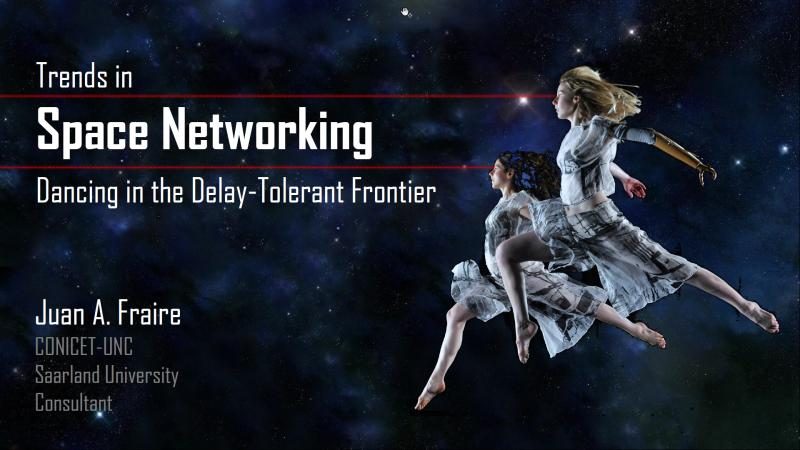
  35. Dancing in the Delay-Tolerant frontier, tomorrow's seminar at LAAS-CNRS, our colleagues from Toulouse, France.

    Title slide: Trends in Space Networking, Dancing in the Delay-Tolerant Frontier, Juan A. Fraire, with two dancers leaping against a starry sky

    On LinkedIn

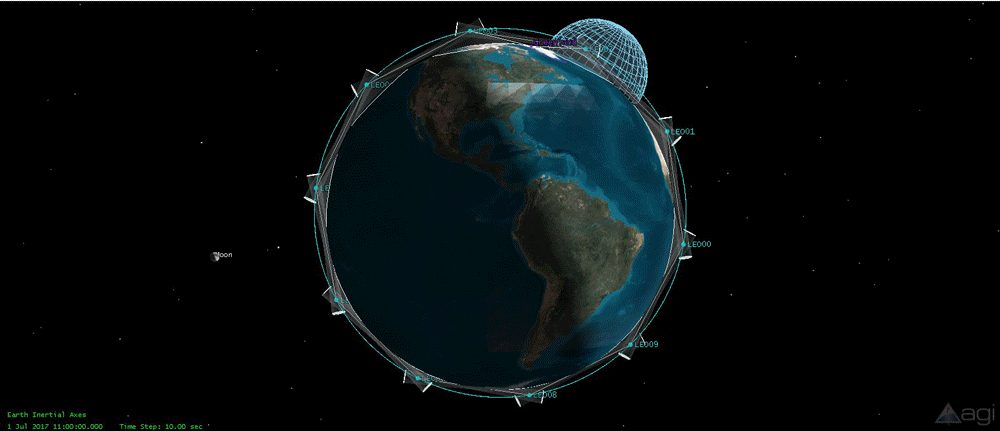
  36. We are releasing Network Toolkit Automator, which controls AGI (Analytical Graphics, Inc.) #STK to generate #LEO constellations in batch mode enabling unique parametric tradeoff analysis. Reach us to try it out!

    AGI STK 3D view of Earth over the Americas, circled by an orbital plane of labelled LEO satellites (LE000, LE001 and others)

    On LinkedIn

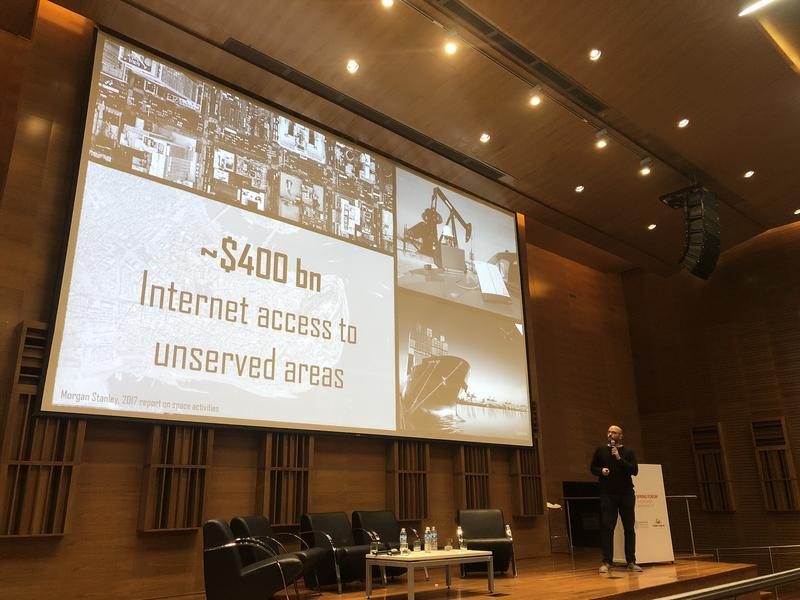
  37. Today I presented how we, at Skyloom Global, plan to support the exponential grow of the space connectivity market. This was at the #DVNArgentina event organized by Draper Cygnus.

    Juan A. Fraire on stage beside a large slide reading ~$400 bn Internet access to unserved areas, citing a 2017 Morgan Stanley report

    On LinkedIn

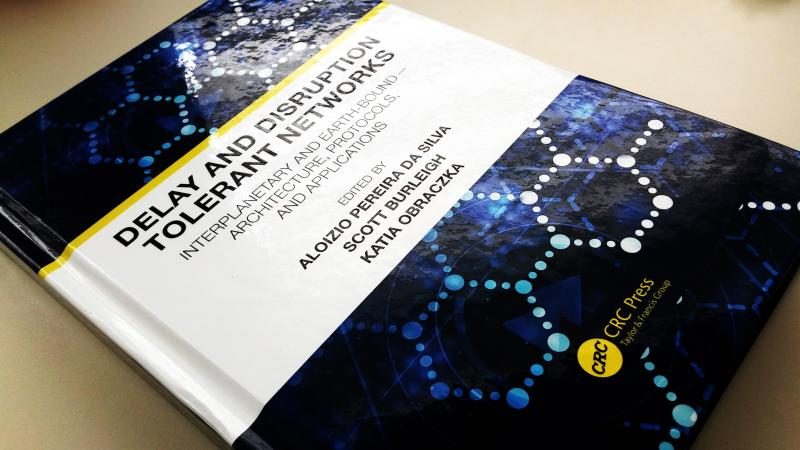
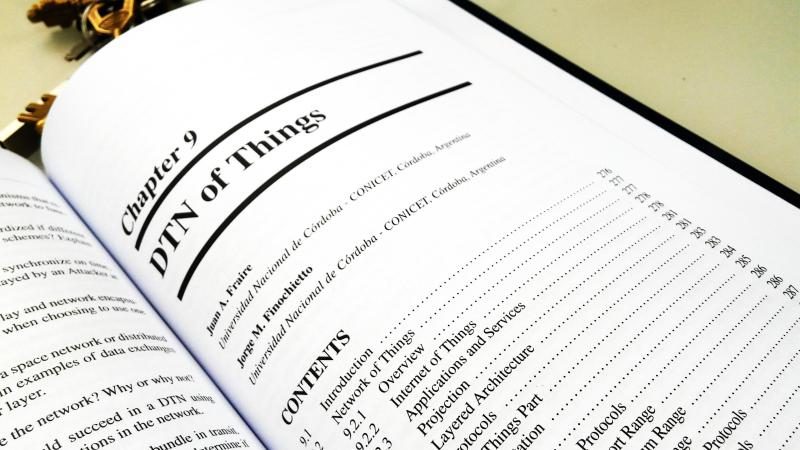
  38. I have just received a printed copy of the "DTN: Interplanetary and Earth-Bound" book where we have collaborated with a "DTN of Things" chapter. A great pleasure working with Aloizio Silva and Scott Burleigh in this manuscript.

    Printed copy of the CRC Press book Delay and Disruption Tolerant Networks, edited by Aloizio Pereira da Silva, Scott Burleigh and Katia Obraczka The book open at Chapter 9, DTN of Things, by Juan A. Fraire and Jorge M. Finochietto, with its contents list

    On LinkedIn

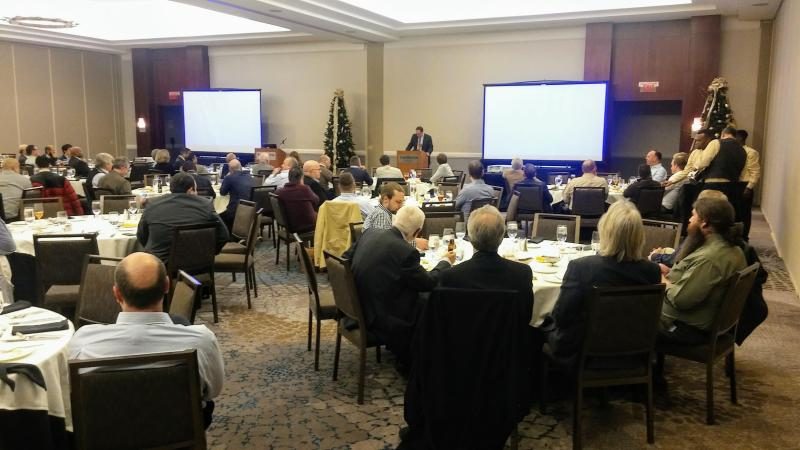
  39. Robert Lightfoot, former NASA administrator, giving a great talk about risk and leading changes in space industry. At #WiSEE2018 banquet with almost 200 attendees!

    Robert Lightfoot speaking at the lectern during the WiSEE 2018 banquet, with attendees at round dinner tables

    On LinkedIn

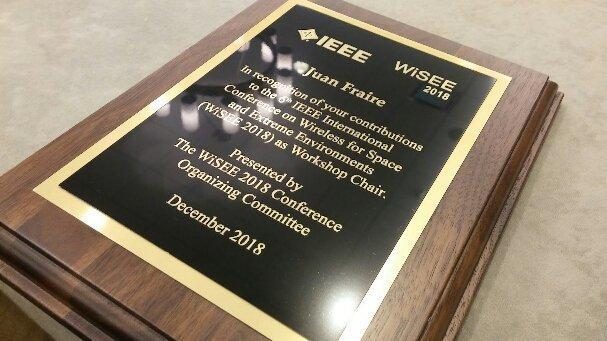
  40. I'm very happy of receiving this recognition from the IEEE Wireless for Space and Extreme Environment #WiSEE2018 community. This is the 2018 edition of the event in #Huntsville, #Alabama, the city were the Saturn V rocket that took the man to the Moon was built. Fantastic moment!

    IEEE WiSEE 2018 plaque presented to Juan Fraire in recognition of his contributions as Workshop Chair, December 2018

    On LinkedIn

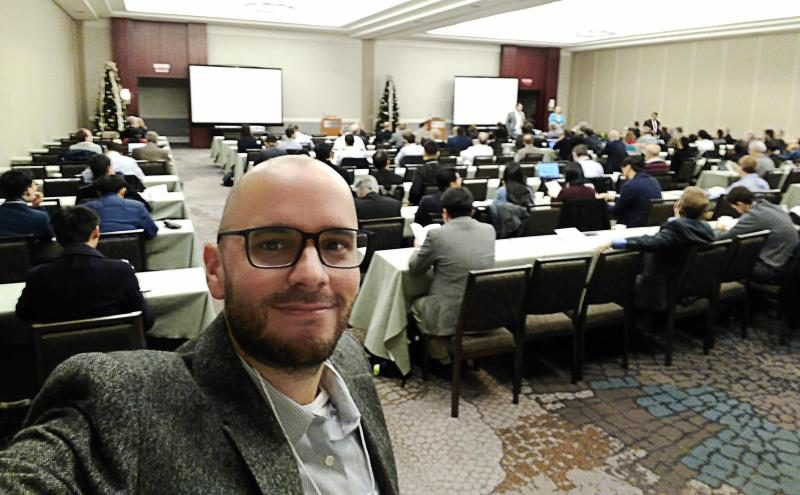
  41. We are kicking off #WiSEE2018 in Alabama, USA, with great talks from NASA Marshall Space-Center representatives. Which are the inhibitors and enablers for replacing wires with wireless technologies in future NASA space missions?

    Selfie in a conference hall at WiSEE 2018, with rows of attendees at tables facing two projection screens

    On LinkedIn

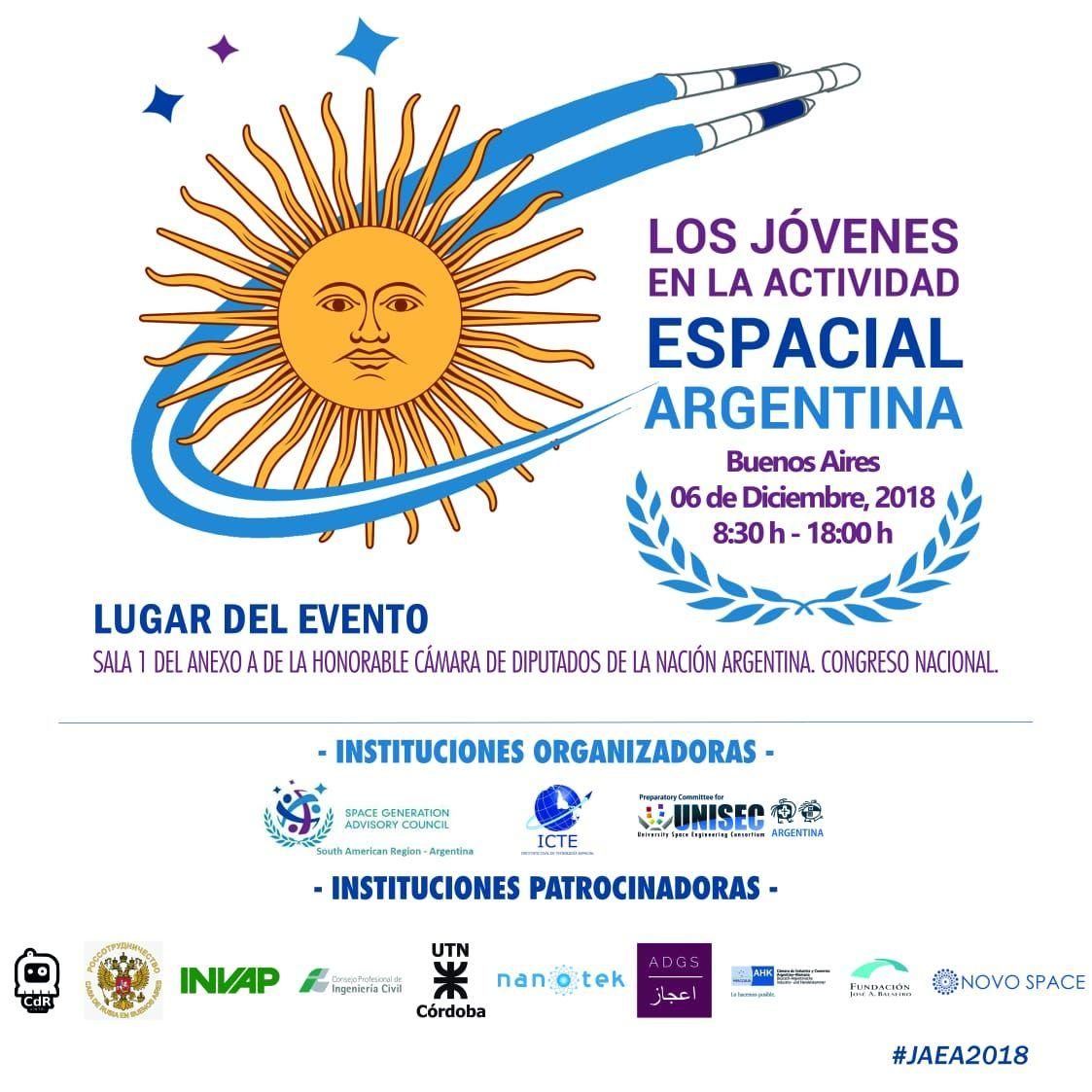
  42. Today we are discussing about how we are supporting CONAE in the definition of future enabler technologies for the national space plan at #JAEA2018, Congreso de la Nacion, Buenos Aires.

    Flyer for Los Jóvenes en la Actividad Espacial Argentina, Buenos Aires, 06 de Diciembre 2018, at the Cámara de Diputados, Congreso Nacional (#JAEA2018)

    On LinkedIn

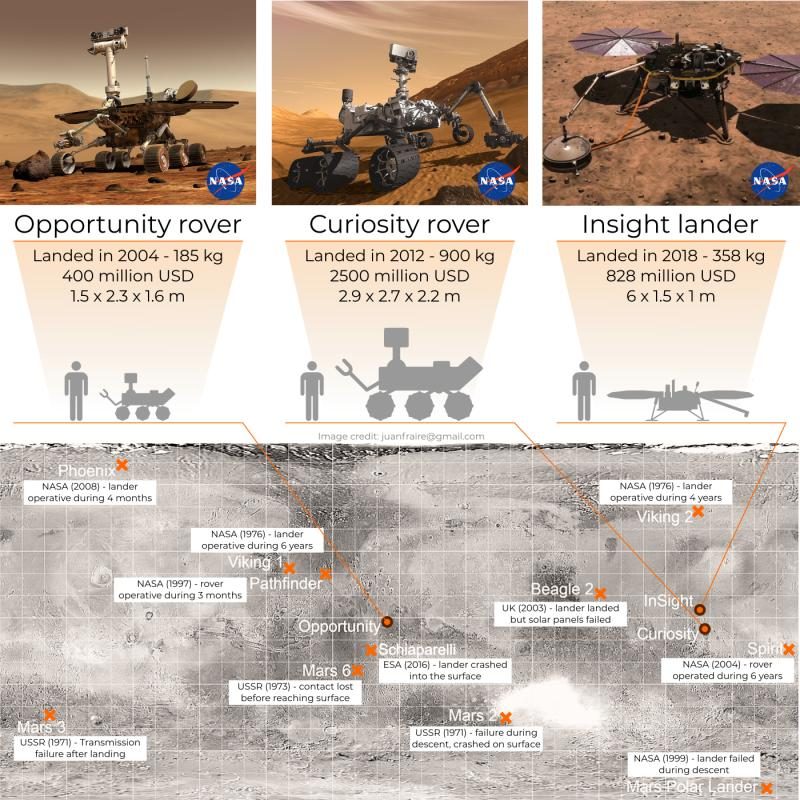
  43. Now that NASA Insight has landed, a small infographic about the three assets currently "operative" on Mars surface, their size, cost and location in the red planet. The quotes in "operative" are because of the Opportunity rover from which we have not received any updates for more than 5 months already...

    Infographic of the Opportunity rover, Curiosity rover and InSight lander with landing year, mass, cost and size, above a Mars map of landing sites

    On LinkedIn

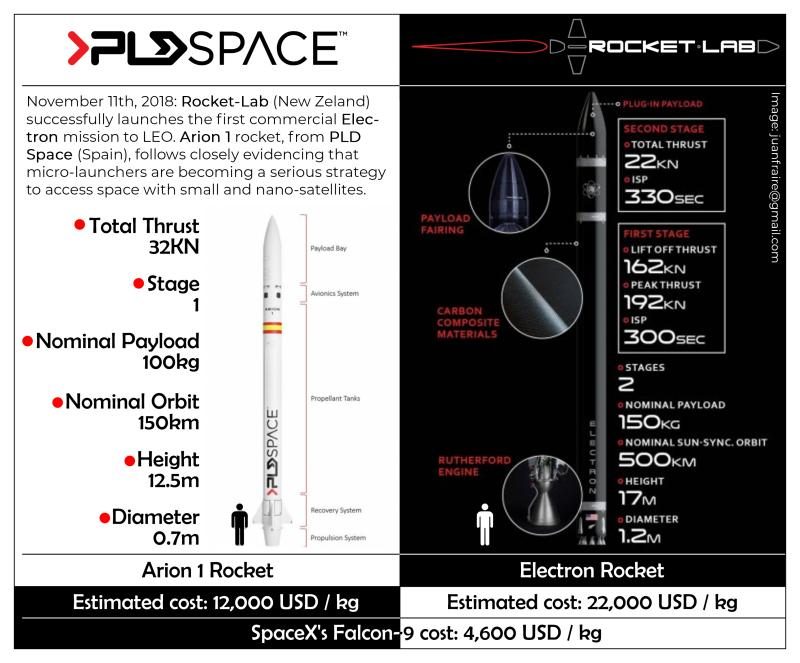
  44. A small infographics comparing two popular micro-launchers from PLD Space and Rocket Lab, having the latter a successful launch yesterday. The space access model is wide open: big and cheap vs small and tailored orbit positioning? Room for both models? Interesting struggle!

    Infographic comparing PLD Space's Arion 1 and Rocket Lab's Electron: thrust, payload, orbit, size and estimated cost of 12,000 vs 22,000 USD / kg

    On LinkedIn

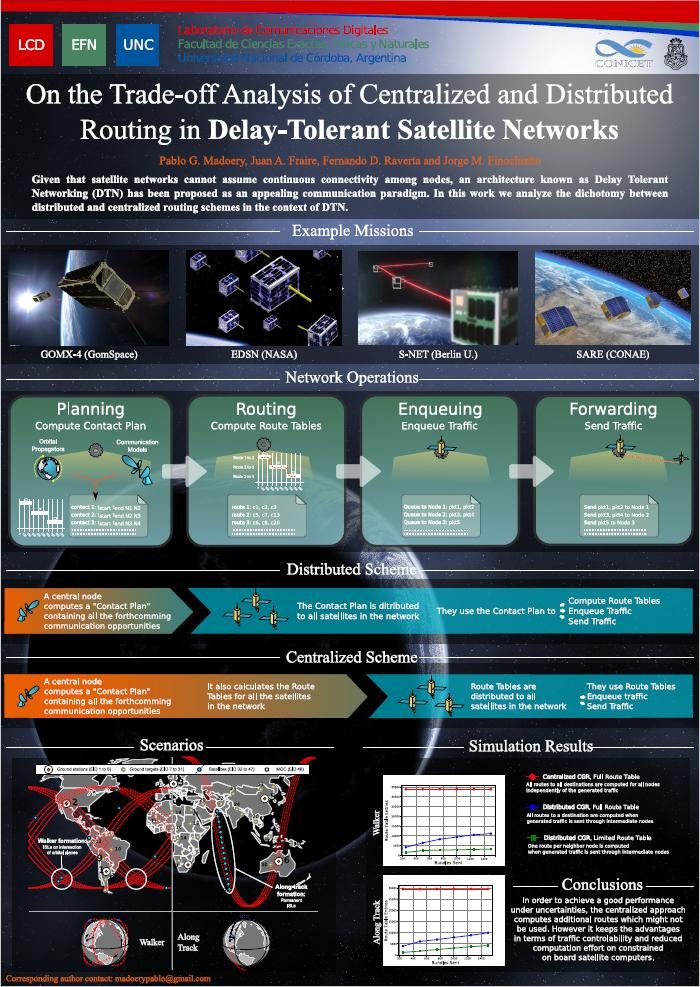
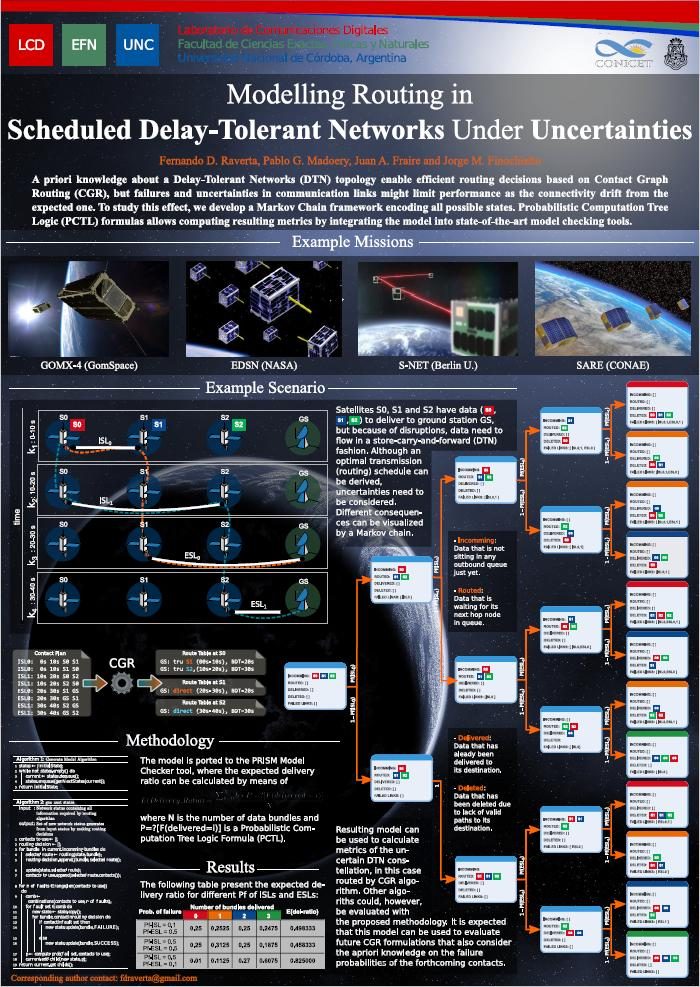
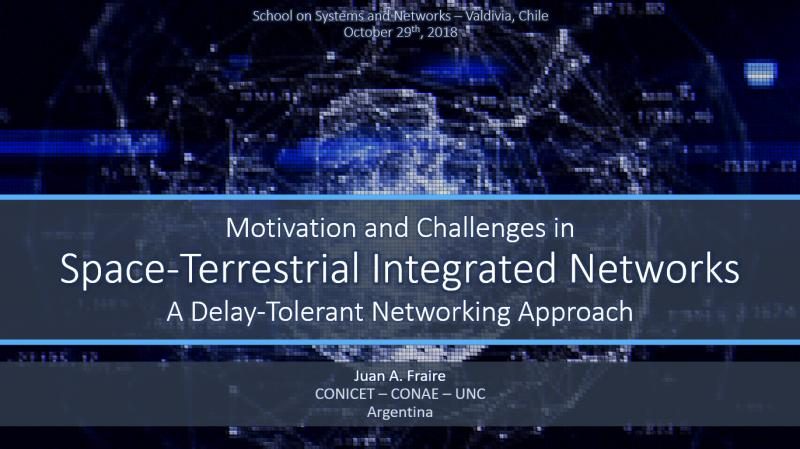
  45. Delay-Tolerant Satellite Network (DTSN) posters packed, DTSN tutorial almost perfect, boarding passes to Valdivia, Chile ready... there we go School on Systems and Networks!

    Research poster: On the Trade-off Analysis of Centralized and Distributed Routing in Delay-Tolerant Satellite Networks Research poster: Modelling Routing in Scheduled Delay-Tolerant Networks Under Uncertainties, with a Markov chain example scenario Tutorial title slide: Motivation and Challenges in Space-Terrestrial Integrated Networks, School on Systems and Networks, Valdivia, Chile

    On LinkedIn

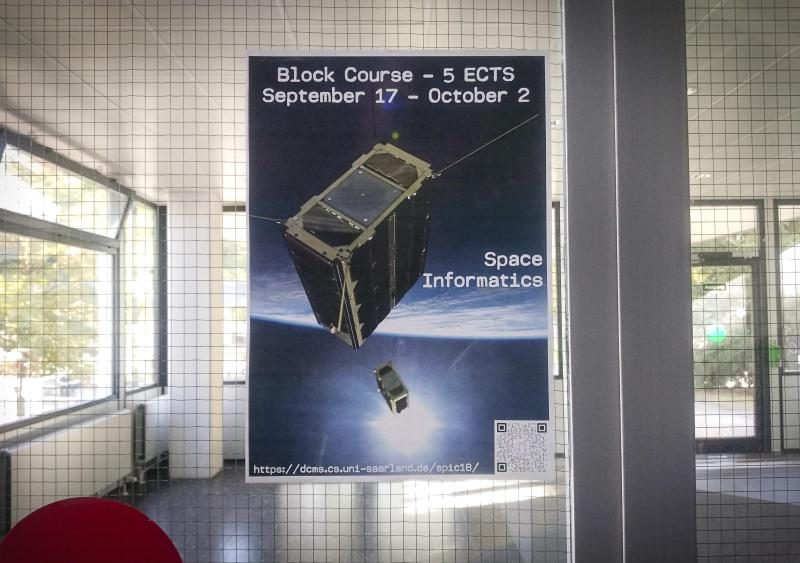
  46. A great course in Universität des Saarlandes. After 10 lectures, 10 practical modules and tutorials, we have covered distributed missions, orbital calculations, launch, maneuvers, communications and networking. Next week, Lars Krogh Alminde, GomSpace founder will join and discuss a bunch more!

    Poster for the Space Informatics block course, 5 ECTS, September 17 - October 2, with a CubeSat in orbit, hung on a glass wall

    On LinkedIn

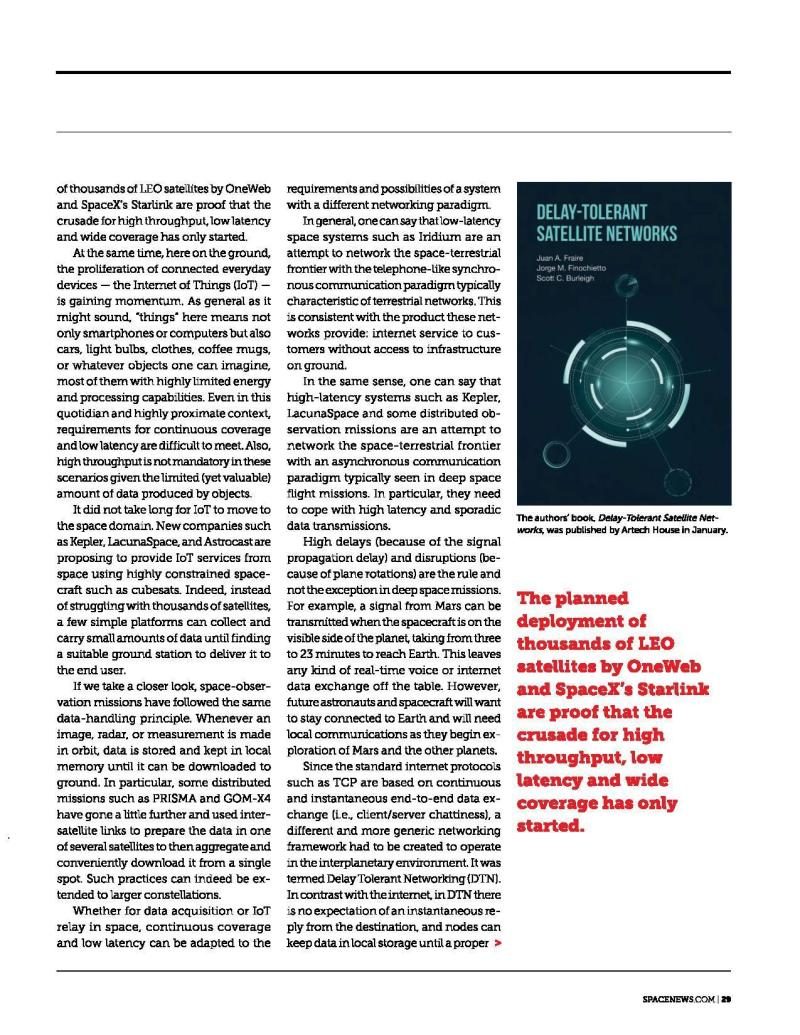
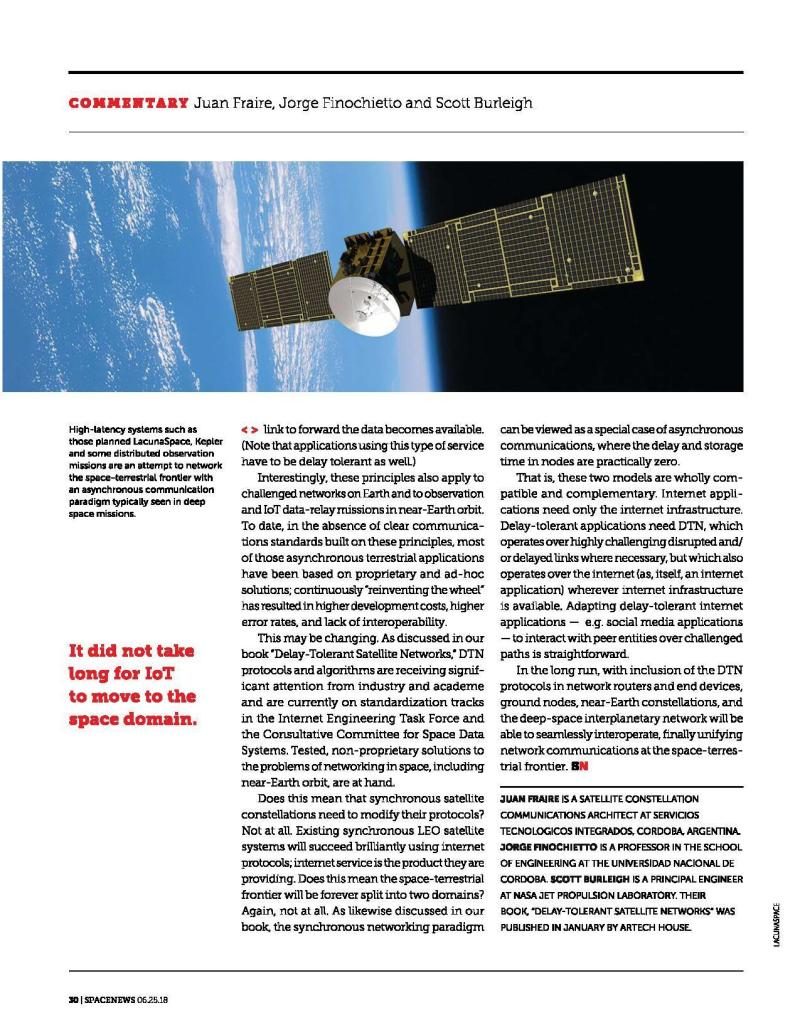
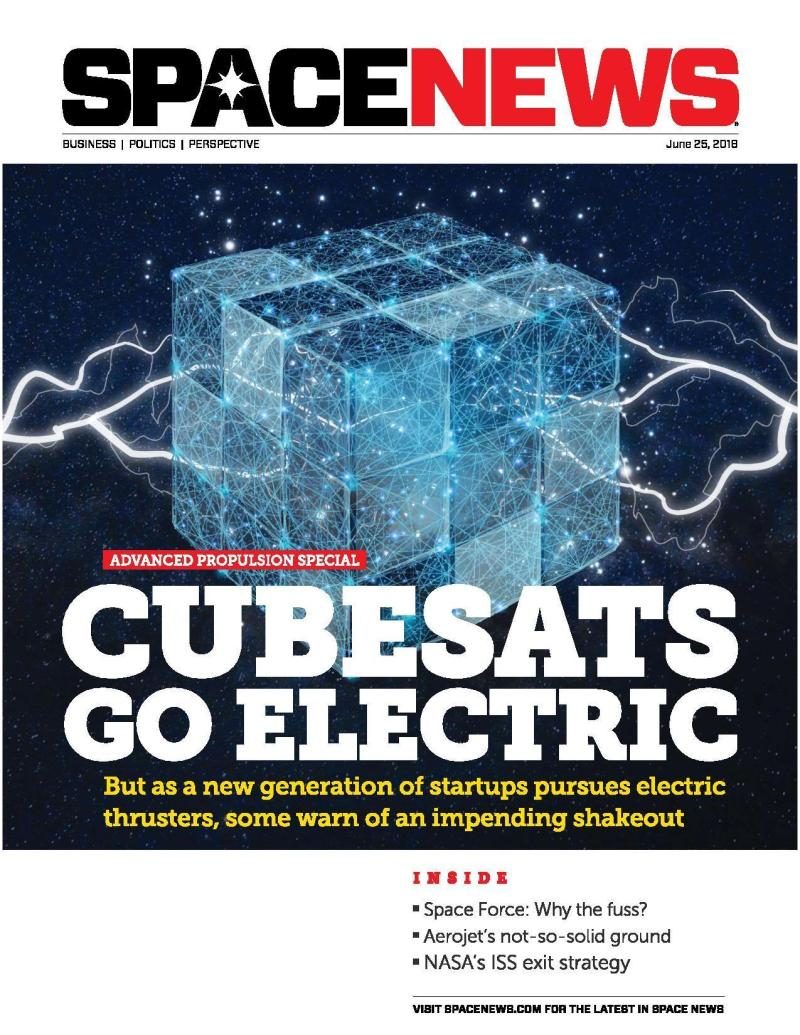
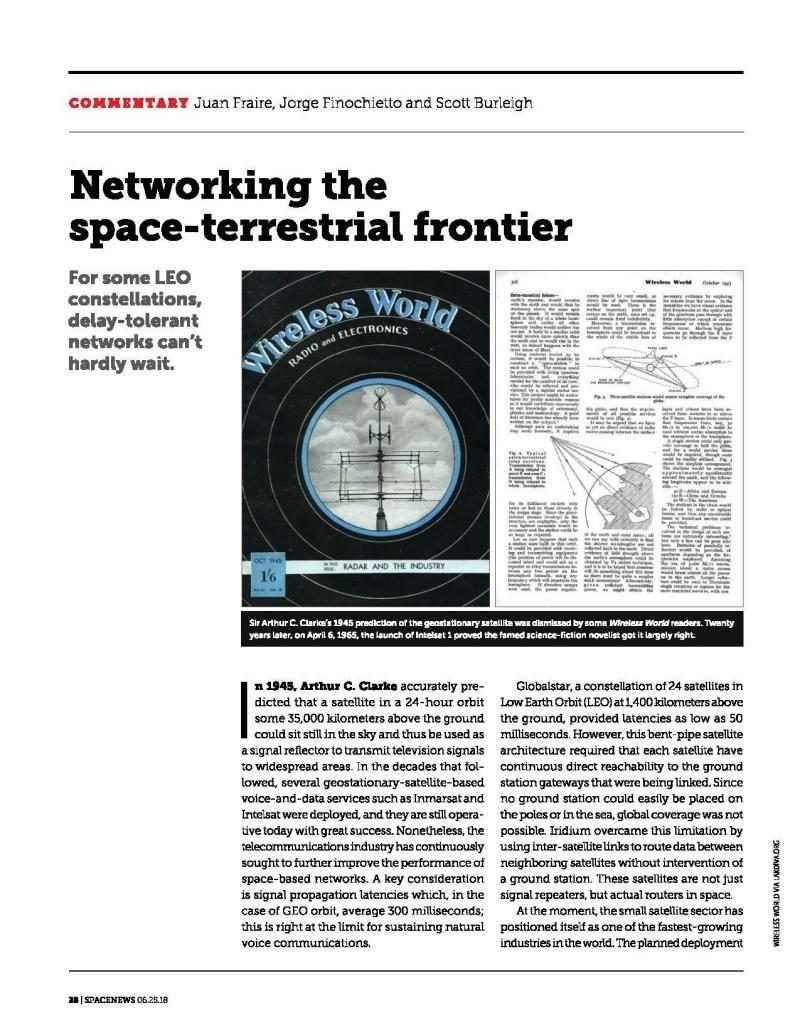
  47. Our commentary letter was picked up by SpaceNews on its prestigious publication covering business and political news in the space industry. We discuss on-going challenges in Networking the Space-Terrestrial Frontier. Full magazine: cdn.coverstand.com/27668/507608/edbf20b4…

    SpaceNews cover, June 25, 2018: Cubesats Go Electric, an advanced propulsion special First page of the SpaceNews commentary by Juan Fraire, Jorge Finochietto and Scott Burleigh: Networking the space-terrestrial frontier Second page of the commentary, with the cover of the authors' book Delay-Tolerant Satellite Networks and a pull quote on OneWeb and Starlink Final page of the commentary, with a satellite above Earth and the authors' biographies

    On LinkedIn

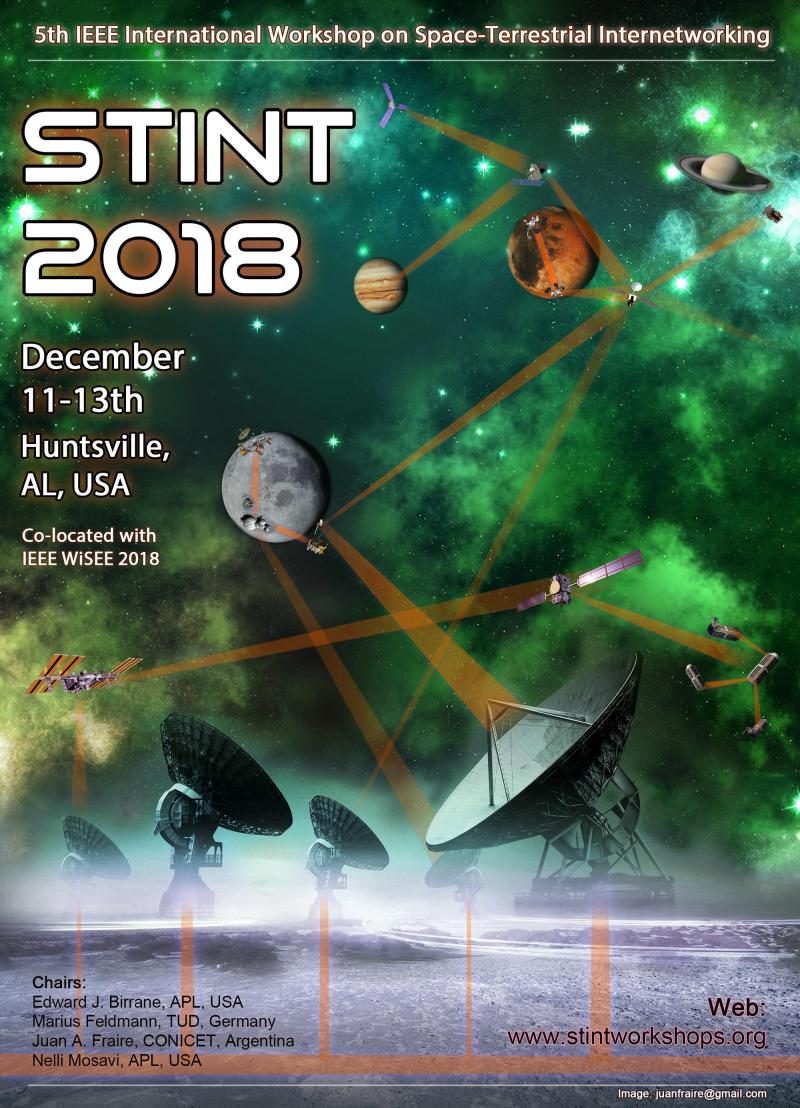
  48. The IEEE Space-Terrestrial Internetworking Workshop (STINT) is going for its 5th edition in Huntisville, AL, USA. Great speakers from NASA, CSA, ESA will enable unprecedented exchanges between academy, government and industry. Submit your paper before Aug 1st and join us! stintworkshops.org

    STINT 2018 poster: 5th IEEE Space-Terrestrial Internetworking Workshop, December 11-13th, Huntsville, AL, USA, co-located with IEEE WiSEE 2018

    On LinkedIn